
INTRODUCTION
Houston, Texas, serves as a cornerstone for the modern mobile culinary movement, fostering a fast-growing ecosystem of entrepreneurs and established restaurants seeking to expand their physical footprint. The Houston Mobile Food Unit (MFU), an industry-standard term defining a vehicle-mounted food establishment that is readily movable, has become a staple of the city’s diverse food landscape. However, the path from a custom-designed unit to a fully operational street-side business requires navigating a rigorous regulatory framework. For business owners, understanding the nuances of fire safety, fuel permitting, and commissary reporting is not merely a legal hurdle but a foundational step in ensuring the longevity and safety of their investment.
As food truck manufacturers focused on high-performance custom builds, Pourter recognizes that compliance begins on the drawing board. In Houston, the requirements are precise, particularly regarding fire suppression and the daily logistics of waste management. This guide breaks down the essential compliance steps for 2026, including the critical shift toward statewide permitting under HB 2844.
The Fire Safety Standard: The Ansul System
In the eyes of the Houston Fire Department (HFD), any mobile food unit that produces grease-laden vapors: typically from fryers, griddles, or charbroilers: is classified as a high-heat operation. For these units, a passive exhaust hood is insufficient. The mandatory standard is a professionally installed, UL 300-compliant fire suppression system, commonly referred to by the industry-leading brand name, Ansul.

The Ansul system is designed to automatically detect fire and deploy wet chemical agents to smother flames and cool hot surfaces. To pass a Houston fire inspection, the system must be:
- Properly Tagged: The system must have a current inspection tag from a licensed fire safety contractor, dated within the last six months.
- Interlocked with Fuel: Upon activation, the system must automatically shut off the fuel supply (propane or electric) to the cooking equipment.
- Strategically Located: A manual pull station must be located along the path of egress, allowing the operator to activate the system while exiting the vehicle.
Failing to maintain a 6-month inspection cycle is the most common reason for a denied Mobile Food Unit permit. At Pourter, we integrate these systems directly into the chassis during the fabrication of our custom food trailers, ensuring that the plumbing and fuel lines are optimized for both performance and inspector approval.
Fueling the Vision: The LP-Gas Permit
For many mobile units, Liquid Petroleum Gas (propane) is the primary energy source. In Houston, the use of propane triggers a specific requirement: the LP-Gas permit. As of 2026, the fee for this mandatory fire code certificate of compliance is $225.14.
This permit isn't just a fee; it represents a comprehensive safety check. HFD inspectors look for strict adherence to NFPA 58 standards. Key areas of focus include:
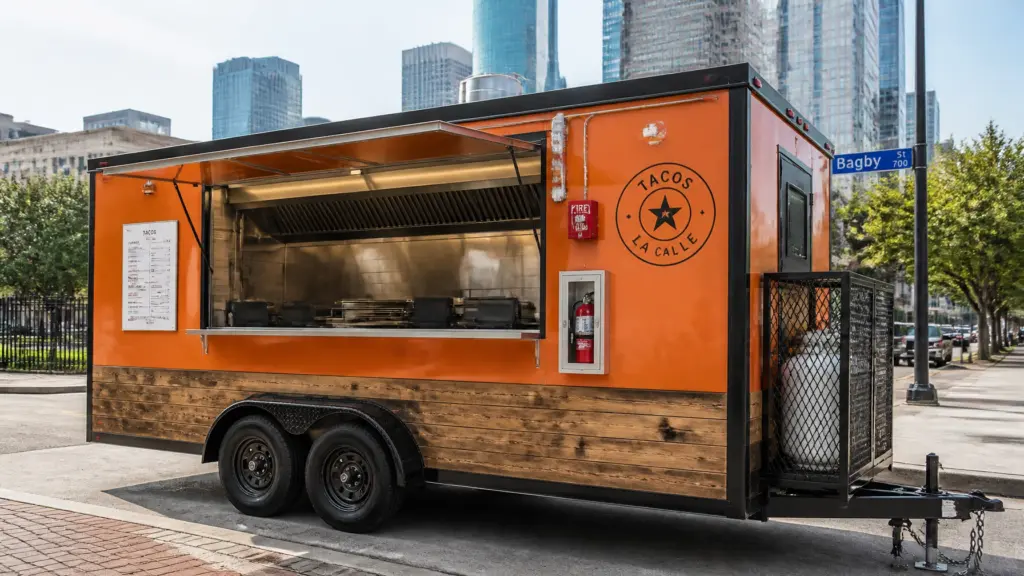
- Cylinder Mounting: Propane tanks must be securely mounted on the exterior of the unit, often on the tongue or a rear-mounted rack, and protected from impact.
- Ventilation: If tanks are housed in a compartment, it must be ventilated at both the top and bottom to prevent gas accumulation.
- Piping and Connections: Flexible gas connectors must not exceed six feet in length, and all joints must be accessible for leak testing.
Owners should view the $225.14 LP-Gas permit as a yearly investment in the safety of their staff and customers. Working with experienced food truck manufacturers ensures that your gas manifold and ventilation are engineered to meet these specific Houston codes from day one.
The Daily Base: Commissary Rules and Tank Ratios
A common misconception among new entrepreneurs is that a mobile food unit is entirely self-sufficient. In reality, the City of Houston requires every MFU to operate from a licensed commissary. This "home base" is where the unit is cleaned, food is prepped in a commercial kitchen environment, and most importantly, where waste is managed.
The 5:6 Water Tank Ratio
Plumbing is perhaps the most scrutinized aspect of the health department's plan review. Houston enforces a strict water tank ratio to prevent overflows and environmental hazards. The standard requirement is a 5:6 ratio.

For every 50 gallons of fresh water your unit carries, you must have at least 60 gallons of wastewater capacity. This 20% buffer ensures that even if you use your entire fresh water supply, your waste tank will not breach its capacity before you return to the commissary.
Daily Reporting
Operating in Houston requires a signed commissary agreement. This document proves that the unit returns to its base of operations daily for:
- Wastewater Disposal: Dumping gray water into an approved grease trap.
- Potable Water Refill: Sourcing water from a safe, tested supply.
- Storage and Prep: Ensuring that bulk supplies are kept in a temperature-controlled, health-inspected facility rather than inside the mobile unit overnight.
The Statewide Horizon: HB 2844 and July 2026
The regulatory landscape in Texas is currently undergoing a transformative shift. Traditionally, a food truck owner moving between Houston, Austin, and Dallas would need separate permits for every single municipality. However, the passage of HB 2844 has paved the way for a statewide mobile food vendor license.
By July 2026, the Texas Department of State Health Services (DSHS) is expected to have fully implemented the reciprocity rules established by this bill. While this simplifies the licensing process for vendors who travel across city lines, it does not eliminate the need for local fire safety inspections.
The Houston Fire Department will still maintain jurisdiction over the Ansul system and LP-Gas inspections within city limits. The "statewide" aspect primarily covers health permitting, meaning your Pourter-built unit will meet a baseline of high standards that are recognized from the Gulf Coast to the Panhandle.
Engineering for Compliance
Building a successful mobile business is a sprint toward the first day of service, but staying in business is a marathon of compliance. Whether you are an existing brick-and-mortar brand like Condado Tacos looking to expand or a local entrepreneur launching a new concept, the technical specifications of your unit are your best defense against downtime.

When you choose to work with specialized food truck manufacturers, you aren't just buying a trailer; you are securing a partner who understands the difference between a "standard" build and a "Houston-compliant" build. From the 5:6 tank ratio to the $225.14 LP-Gas permit preparation, every weld and wire in a Pourter unit is designed to get you through the inspection line and onto the streets of Houston.
The momentum of the Houston food scene is undeniable. By prioritizing these fire safety and commissary rules during your design phase, you ensure that your mobile unit is a stable, profitable extension of your brand for years to come.