
INTRODUCTION
Pourter, a premier manufacturer of high-end mobile hospitality units, is the cornerstone of the modern street-food and mobile retail movement. In an industry defined by rapid growth and intense competition, the physical layout of your mobile kitchen is often the difference between a high-volume success and a logistical bottleneck. For entrepreneurs and established brick-and-mortar brands expanding into the mobile space, the blueprint is the foundation of the brand’s reputation.
Building a custom food trailer is a significant investment that requires more than just aesthetic appeal. While a sleek exterior wrap is vital for marketing, the internal mechanics of the unit determine your daily output and staff retention. Many operators searching for custom food trailers near me are often comparing build quality, workflow, and long-term durability, not just appearance. Many operators also start researching food trailer layout near me when they realize too late that their equipment placement hinders speed or that their weight distribution makes the unit a liability on the road. This guide identifies the seven most common mistakes made during the design phase and provides the technical solutions necessary to optimize your mobile kitchen layout.
Key Takeaways
- Design your trailer around your menu, not around a generic equipment package.
- Maintain proper weight distribution and keep heavy components balanced over the axles.
- Build a linear prep-to-cook-to-serve workflow to reduce staff cross-traffic.
- Preserve 3 to 4 feet of aisle clearance to support faster, safer movement.
- Use vertical storage and proper ventilation to improve efficiency in compact spaces.
- Work with experienced builders on food trailers and bar/beverage trailers to future-proof the unit for growth.
1. Designing for the Trailer, Not the Menu
The most frequent mistake in the industry is choosing a trailer size and then attempting to force a kitchen into it. At Pourter, we advocate for the "Menu-First" Rule. Every inch of your efficient food truck design must be justified by your high-volume items.
If your signature dish is Nashville hot chicken, your layout requires a high-capacity fryer station with immediate access to a dedicated breading area. Conversely, if you are running a high-end mobile bar, your workflow should prioritize ice accessibility and speed-rail ergonomics. Operators looking up food trailer layout near me are often trying to solve this exact issue: matching the floor plan to the menu instead of forcing the menu into a generic build. A common error is installing a "standard" kitchen package that includes equipment you rarely use, which consumes valuable square footage and increases utility costs. If your concept leans more toward cocktails, coffee, or specialty drinks, studying proven bar/beverage trailer configurations can help you avoid wasted space from day one.
The Fix: Audit your menu before sketching the floor plan. Identify your top three best-selling items and map out every physical step required to produce them. If an appliance doesn't serve those three items, reconsider its place in your 16-foot or 20-foot unit.
2. Neglecting Weight Distribution 101
A food trailer is a vehicle before it is a kitchen. Improper weight distribution is a safety hazard that causes trailer sway and excessive wear on your tow vehicle. Many first-time owners place all their heavy refrigeration on one side and their water tanks at the very rear, leading to a dangerous imbalance.
Technical stability relies on the tongue weight: the pressure applied to the hitch of the tow vehicle. This should generally stay around 10% to 15% of the Gross Vehicle Weight (GVW).
The Fix: Keep heavy equipment, such as commercial refrigerators and full water tanks, balanced over the axles. If you are operating a Nashville food truck, you must account for the "wet weight" of your fresh and grey water. Distribute the load so the trailer remains level, ensuring a safer commute between events and catering gigs.

3. Creating Cross-Traffic Chaos
Efficiency in a mobile unit is built on a linear workflow. In a cramped environment, every time an employee has to cross paths with another to reach a fridge or a trash can, service slows down. Non-linear layouts lead to "collision zones" that frustrate staff and increase ticket times.
The Fix: Organize your trailer in a logical sequence: Prep -> Cook -> Serve.
- Prep Zone: Located near refrigeration and dry storage.
- Cook Zone: Centered under the ventilation hood.
- Service Zone: Directly adjacent to the service window for easy hand-offs.
By keeping the flow moving in one direction, you maximize the number of orders you can process during a lunch rush without increasing your staff count.
4. Failing to Maximize Vertical Space
Counter space is the most valuable real estate in a custom food trailer. A common mistake is cluttering these surfaces with small appliances, spice racks, and utensil bins. When your counters are covered, you lose the ability to plate multiple orders simultaneously.
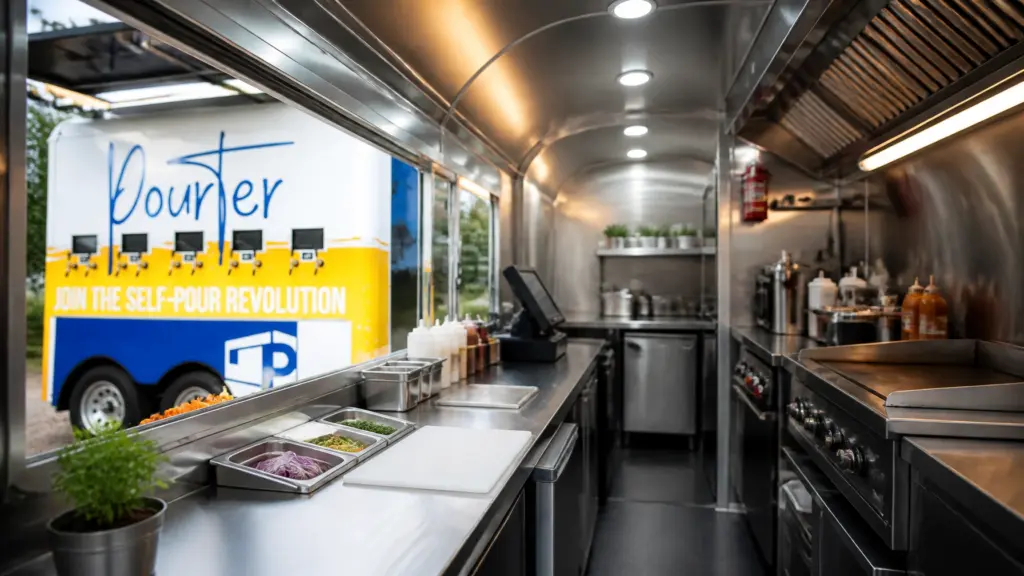
The Fix: Use vertical maximization. Install high-mounted wall shelving for dry goods and disposables. Use magnetic strips for knives and metal utensils to keep them within reach but off the workspace. Pourter units are designed with rounded corners and sleek finishes that accommodate integrated shelving without making the space feel claustrophobic.

5. Ignoring the 3-4 Foot Clearance Rule
While it is tempting to pack as much equipment as possible into a trailer, the "aisle" is where the money is made. Many manufacturers create units with aisles so narrow that two people cannot pass each other without one person stepping outside. This creates a "one-in-one-out" bottleneck that caps your revenue.
The Fix: Maintain a minimum of 3 to 4 feet of clearance in the main work aisle. This allows for back-to-back staff movement. If your team can move freely, they can support each other during peak hours, ensuring that the "assembly" and "plating" stages don't become the weak link in your chain.
6. Mismanaging Ventilation and Heat Zones
In high-temperature markets like Austin or Dallas, heat management is a matter of staff safety and equipment longevity. A common mistake is under-sizing the exhaust hood or placing heat-generating equipment (like fryers) directly next to cooling units (like reach-in freezers). This forces your refrigeration to work twice as hard, leading to premature compressor failure.
The Fix: Invest in a high-quality, oversized ventilation hood that extends at least 6 inches beyond your cooking line on all sides. When navigating Austin food truck permits, proper ventilation is a non-negotiable requirement. Ensure your "Hot Zone" is physically separated from your "Cold Zone" to maintain a comfortable working temperature and protect your inventory.
7. Building for Today, Not Next Year
Success in the mobile food industry often comes faster than expected. A mistake many entrepreneurs make is choosing a small, 10-foot unit to save on initial costs, only to outgrow it within six months. Upgrading a trailer is significantly more expensive than building the right size from the start.
The Fix: Future-proof your business. If you plan to expand your menu or add a second service window in the future, ensure your chassis and electrical system can handle the load. As reputable food truck manufacturers, we recommend looking at your three-year growth plan before finalizing your dimensions. A slightly larger unit provides the flexibility to scale without the need for a total rebuild.

Conclusion: The Pourter Advantage
A high-performing mobile unit is a synergy of engineering and culinary strategy. By avoiding these common layout mistakes, you ensure that your business is prepared for the rigors of high-volume service. Whether you are navigating the complexities of Austin food truck permits or launching a new concept in Nashville, the design of your unit is your most powerful tool.
At Pourter, we specialize in building custom mobile units that prioritize workflow, safety, and brand impact. Our rounded-corner designs and professional-grade interiors are crafted to meet the needs of serious operators who demand the best.
Ready to design a layout that works as hard as you do? If you have been comparing custom food trailers near me and want a builder that prioritizes workflow, safety, and long-term performance, contact the Pourter team today to start your custom build.