
Key Takeaways
- Battery-powered food trailers are becoming the practical answer to tighter urban noise and emissions enforcement.
- Silent operation improves customer experience, expands venue access, and strengthens brand perception.
- Long-term maintenance and operating costs are often lower with battery systems than with gas generators.
- Battery swapping is emerging as an important solution for vendors who need all-day runtime without long charging downtime.
- Pourter builds mobile units around efficient layouts, rounded-corner designs, and full-unit branding for modern urban deployment.
INTRODUCTION The internal combustion generator, a long-standing cornerstone of the mobile vending industry, is rapidly losing its status as the default power source for street-level entrepreneurs. As cities like New York and Los Angeles tighten their grip on noise ordinances and environmental regulations, the traditional hum of a gas-powered engine is increasingly viewed as a liability rather than a necessity. For decades, these noisy, exhaust-spewing units were the only viable way to power high-draw equipment in a mobile environment, but a transformative shift toward battery-powered solutions is redefining the landscape of the modern custom food trailer.
This movement is not merely a trend driven by environmental idealism; it is a calculated response to the logistical and legal pressures of operating a business in densely populated urban centers. As the industry moves away from fossil fuels, the focus has shifted toward high-capacity lithium-ion systems and innovative battery-swapping models that allow for silent, emission-free operation without sacrificing the power needed for commercial-grade refrigeration, espresso machines, and induction cooktops.
The Growing Pressure of Urban Regulation
The transition toward a battery powered food cart or trailer is being accelerated by the evolving legislative environment in major metropolitan areas. In cities where sidewalk space is at a premium, the external impact of a business: specifically its noise and air quality footprint: is under intense scrutiny.
In Los Angeles, Municipal Code §42.13 and citywide noise ordinances allow officials to enforce strict decibel limits on mechanical devices. A gas generator running at full tilt often exceeds these limits, especially when operating in proximity to residential zones or outdoor dining areas. Similarly, in New York City, where an estimated 20,500 street vendors compete for the attention of millions of pedestrians, the push for "power taps" and battery-centric infrastructure is gaining momentum. The goal is clear: eliminate the "nuisance" factor of street vending to ensure these businesses remain a welcome part of the community fabric.
For the entrepreneur, a violation of these noise standards is more than a minor inconvenience; it can result in heavy fines, permit revocations, and a damaged reputation with the local Business Improvement District (BID). By adopting sustainable power, vendors are effectively future-proofing their operations against the inevitable expansion of "zero-emission zones" and more aggressive noise enforcement.

The Silence of Success: The Business Case for Batteries
Beyond the legal requirements, there is a powerful psychological and economic argument for the silent operation of a battery powered food trailer. For operators searching for a battery powered food trailer near me, the value proposition is increasingly tied not just to compliance, but to customer comfort, venue flexibility, and long-term operating efficiency. A traditional gas generator creates a physical and auditory barrier between the vendor and the customer. The constant roar of an engine makes communication difficult, forcing customers to shout their orders and discouraging them from lingering near the unit.
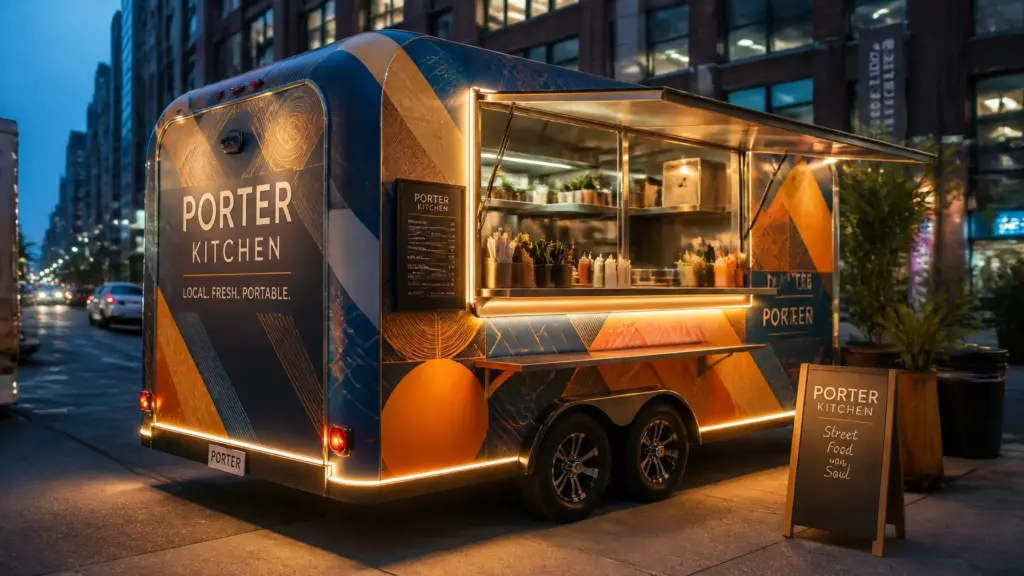
In contrast, a battery-powered unit operates in near-total silence. This creates a more inviting atmosphere, akin to a permanent brick-and-mortar establishment. When the background noise is eliminated, the focus returns to the product, the branding, and the customer experience. At Pourter, we design our units with this "good neighbor" philosophy in mind. Our trailers, characterized by their signature rounded corners and sleek, full-unit wrap graphics, are designed to attract attention through visual appeal rather than auditory disruption.
Efficiency and Maintenance Reductions
While the initial investment in a high-capacity battery system can be higher than a standard portable generator, the long-term ROI is significant. Gas generators require constant refueling, frequent oil changes, and regular spark plug replacements. They are mechanical systems with numerous moving parts prone to failure under the heavy-duty cycles of daily vending.
Battery systems, conversely, have virtually no moving parts. The maintenance schedule is drastically reduced, and the cost per kilowatt-hour of electricity: whether sourced from a shop plug-in or an urban power tap: is consistently lower than the cost of gasoline or propane. Furthermore, many modern units are being integrated with solar arrays on their rooftops, providing a "trickle charge" that extends the life of the battery bank throughout the day.

Engineering the Future: How Pourter is Leading the Charge
At Pourter, we recognize that the shift to sustainable power requires more than just swapping a fuel tank for a battery. It requires a fundamental rethink of the custom food trailer architecture. For brands researching custom food trailers near me, that engineering difference matters, especially in dense city environments where every decibel, every amp, and every square foot of workflow counts. Our engineering team focuses on maximizing energy efficiency throughout the build, from LED lighting and high-R-value insulation to the selection of energy-star-rated appliances.
The aesthetic of the unit is just as important as its power source. A modern, sustainable business should look the part. We avoid the "blocky" and industrial look of traditional food trucks in favor of smooth, aerodynamic lines and rounded corners. Every unit we produce is treated as a mobile brand activation, featuring full-unit wraps that turn the trailer into a high-end piece of rolling architecture.
The Rise of Battery Swapping
One of the most exciting developments in the industry is the emergence of battery-swapping technology. For vendors who operate long hours or lack access to overnight charging, the ability to quickly swap a depleted battery module for a fully charged one is a game-changer. This model eliminates "range anxiety" for the kitchen, ensuring that the lights stay on and the refrigerators stay cold regardless of how far the unit is from its home base.

Impact on Brand Reputation and Community Integration
In the modern market, consumers are increasingly conscious of the environmental footprint of the businesses they support. A food brand that operates silently and without the smell of diesel exhaust immediately positions itself as a premium, forward-thinking entity. This is particularly important for multi-unit restaurant chains and coffee shops looking to expand their footprint with a mobile presence.
A battery powered food cart can operate in locations where gas units are strictly forbidden: indoor malls, private event spaces, and high-end corporate campuses. This flexibility opens up new revenue streams that were previously inaccessible to traditional street vendors. By removing the generator, the mobile unit becomes a versatile tool for brand activation that can move seamlessly between outdoor festivals and indoor trade shows. For operators comparing formats, Pourter’s urban food trailers show how city-ready builds can balance compact footprints, polished branding, and sustainable performance, while the gallery offers real-world examples of how those concepts translate into finished units.

Conclusion: The New Standard for Mobile Excellence
The era of the noisy, vibrating, and polluting gas generator is coming to a close. As urban environments become more regulated and consumer expectations continue to rise, the transition to sustainable power is no longer an optional upgrade: it is a requirement for survival and growth.
Whether you are an entrepreneur launching your first venture or an established brick-and-mortar looking to scale, the choice of power will define your operational success. By investing in a custom food trailer designed for the battery-powered age, you are choosing a path of efficiency, community respect, and long-term viability. At Pourter, we are committed to building the future of mobile commerce, one silent, beautifully wrapped, and expertly engineered unit at a time.
For more information on how we can help you transition to a sustainable mobile unit, explore our about page or contact our design team today.