
Key Takeaways
- New York City is testing rechargeable battery systems as an alternative to traditional diesel generators for mobile food vendors.
- The 2026 Clean-Powered Carts Challenge began with 10 vendors in Queens and is designed to evaluate cleaner, quieter, and scalable street-vending power.
- A battery-first design can support refrigeration, lighting, ventilation, cooking equipment, and point-of-sale systems without producing on-site exhaust.
- For entrepreneurs planning a 5×10 food trailer or mobile beverage unit, battery capacity, safe installation, service access, and daily charging logistics should be considered at the beginning of the build.
- Pourter builds custom mobile food and beverage units with integrated power options, full-unit branding, and layouts designed around each operator’s menu and service model.
INTRODUCTION
New York City street vending is a cornerstone of the city’s food economy, serving millions of residents, workers, and visitors across all five boroughs. Its next major transformation is already underway: replacing loud, fuel-powered generators with rechargeable battery systems.
In July 2026, the City launched the NYC Clean-Powered Carts Challenge, a six-month pilot involving 10 mobile food vendors in and around Flushing Meadows Corona Park. The program is testing battery power as a practical alternative to diesel generators while examining safety, affordability, vendor usability, and scalability.
The project moves clean-energy street vending from a long-term goal to an active operating model. For established food businesses, first-time entrepreneurs, and operators researching custom food trailers, the message is direct: power strategy now belongs at the center of mobile-unit design.
Why Is NYC Testing Battery-Powered Food Carts?
NYC’s mobile food vendors are essential small businesses, but many depend on generators to operate refrigeration, lighting, ventilation, and other equipment. Those generators can create noise, exhaust, and higher fuel costs during long shifts.
According to the city’s announcement, New York has approximately 20,500 licensed food vendors. If battery-powered systems were expanded across the sector, the city estimates a potential reduction of more than 120,000 metric tons of carbon dioxide emissions each year: the equivalent of removing nearly 30,000 cars from the road.
The Queens pilot is also a response to working conditions. Vendors may spend 10 to 12 hours beside their equipment, often in dense public spaces where generator noise and emissions affect vendors, customers, residents, and nearby businesses.
The pilot uses rechargeable batteries that vendors can pick up, exchange, or receive through delivery, depending on their operating location. The City is working with NYC Parks, the FDNY, the Street Vendor Project, City Parks Foundation, and battery provider PopWheels to assess the model.
This is not simply a technology demonstration. It is a test of whether clean power can function within the time, space, cost, and safety requirements of real street vending.

What Does “Zero-Emission” Mean for a Mobile Food Unit?
A battery-powered cart or trailer produces no tailpipe emissions while it is operating. That makes it a zero-emission solution at the point of use, particularly when it replaces a gasoline or diesel generator.
The broader environmental impact depends on how the electricity is generated and how the batteries are manufactured, charged, maintained, and eventually recycled. Even with that consideration, battery-first equipment can significantly improve conditions on the street by eliminating local exhaust and reducing noise.
For a custom food trailer, zero-emission operation can include:
- Refrigeration and freezer systems powered by lithium batteries
- LED lighting throughout the prep and service areas
- Ventilation and exhaust equipment designed around available power
- Induction cooking equipment where the menu permits
- Point-of-sale systems, Wi-Fi, and digital menu displays
- Battery charging, swapping, or shore-power connections
- Solar integration where the operating model and roof area allow it
The correct system depends on the menu, operating hours, equipment load, climate, and service location. A coffee trailer with espresso equipment has a different energy profile from a concession trailer serving cold beverages or a mobile bar supporting refrigeration and draft systems.
That is why battery planning should happen before fabrication: not as an afterthought once the unit is already built.
How Should Vendors Design a Battery-First 5×10 Unit?
A 5×10 footprint gives operators a compact, efficient platform for high-visibility vending locations. It can also support a focused menu, coffee service, beverage activation, or a specialized food concept without the cost and maneuverability challenges of a full-size food truck.
A battery-first 5×10 build should address five practical questions.
1. What equipment must run at the same time?
List every electrical load, including refrigeration, cooking equipment, water pumps, lights, ventilation, POS systems, and charging stations. Peak demand matters as much as total daily consumption.
2. How long is the operating shift?
A short service window at an event may require a different battery capacity than an all-day street-vending operation. NYC vendors should plan for realistic shifts, including setup, service, breakdown, and unexpected demand.
3. Is charging available at the operating location?
Some operators can recharge overnight at a commissary or home base. Others may need battery swapping, delivery, shore power, or a hybrid system. The power plan should match the actual route and location: not an idealized schedule.
4. How will the battery system be accessed and protected?
Battery modules, inverters, disconnects, and controls need safe, serviceable locations. A professional build should keep electrical components protected from water, heat, impact, and unnecessary customer access while allowing technicians to inspect and maintain them.
5. Can the unit be inspected and operated safely?
Battery technology does not remove the need to comply with applicable city, fire, health, electrical, and mobile-vending requirements. Equipment selection and installation should be reviewed with qualified professionals and the relevant authorities before operation.
Pourter’s previous guidance on lithium battery power for food trucks and trailers outlines the advantages of lithium systems, including energy density, lower maintenance, lighter weight, and long service life.

How Can Battery Power Improve the Customer Experience?
Clean power affects more than operating costs. It changes how a mobile unit fits into a neighborhood, park, event, or commercial district.
Removing a running generator creates a quieter service environment. Customers can order more comfortably, staff can communicate more easily, and nearby businesses face less mechanical noise. The absence of visible exhaust also makes the unit more appropriate for parks, pedestrian areas, campuses, and branded activations.
A battery-first system can support a more refined design as well. Without designing around a generator enclosure or fuel storage, manufacturers can create cleaner service zones, more efficient storage, and better sightlines around the unit.
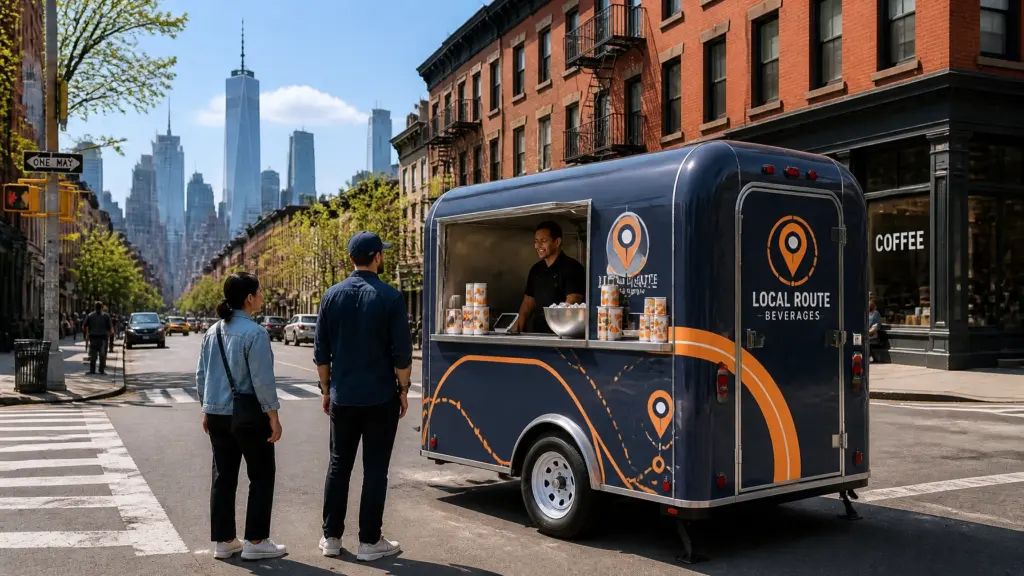
The exterior matters, too. In a crowded city market, a full-unit wrap is more effective than a small logo applied to a blank shell. Pourter’s custom mobile units are designed around complete visual identities, with rounded profiles and branded graphics that help a business stand out from a busy curbside environment.
Explore Pourter’s custom food trailer projects for examples of mobile kitchens built around distinct menus and operating needs. Beverage operators can also review bar and beverage trailers for service concepts that require refrigeration, lighting, draft systems, or guest-facing display equipment.
Is Battery Power Practical for Food Trailers Near Me?
For operators searching “food trailers near me,” “custom food trailers,” or “food trailer near me,” the key question is not whether batteries are fashionable. It is whether the system can reliably support the specific business.
Battery power is especially relevant for:
- Coffee trailers operating near offices, parks, and transit hubs
- Custom food trucks and trailers serving compact menus
- Mobile bars at private events and branded activations
- Concession trailers in parks, campuses, and public venues
- Restaurant groups testing a second service location
- Retail brands using a mobile unit for sampling and customer engagement
Pourter offers battery, solar, and electric power options as part of its custom fabrication process. Its food trailer and mobile unit portfolio can help operators compare formats before finalizing equipment and layout decisions.
Battery-first operation is also compatible with a phased approach. A vendor might begin with a rechargeable battery system, add shore-power capability where available, and evaluate solar integration as the business expands. The goal is to build flexibility into the unit without overloading the initial budget or sacrificing service performance.
What Does This Mean for Vendors in NYC, Austin, and Chicago?
New York City is currently the most visible test market because of its dense vending network, extensive public-space use, and active clean-energy initiatives. Queens, particularly Flushing Meadows Corona Park, is establishing an early operating model that could inform future programs in Manhattan, Brooklyn, the Bronx, and Staten Island.
If you are looking for a custom food trailer in NYC, the city’s pilot is a useful signal: equipment power, fire safety, and charging logistics will likely become increasingly important in procurement and site planning.
The same principle applies outside New York. An operator researching food trailers for sale in Austin may benefit from battery power at festivals, outdoor markets, and areas where generator noise is restricted. In Chicago, a battery-powered coffee trailer or mobile bar can provide a quieter experience for parks, campuses, and private events.
Local codes and approval processes vary, so operators should confirm requirements with the relevant authorities in each market. But the broader direction is consistent: cities are looking for mobile businesses that can operate efficiently while reducing neighborhood impacts.
How Can a Business Start Planning a Battery-First Build?
Start with the business model, not the equipment catalog. Define the menu, service hours, target locations, staffing, storage needs, and expected daily volume. Then work with a manufacturer to develop an electrical load schedule and layout.
The build conversation should include:
- Battery capacity and expected runtime
- Charging or swapping arrangements
- Equipment voltage and startup requirements
- Ventilation, refrigeration, and water systems
- Fire-safety and service-access provisions
- Weight distribution and towing considerations
- Exterior wrap design and customer visibility
- Future expansion options
Pourter works with entrepreneurs, restaurants, bars, cafes, and multi-unit operators to create custom mobile food and beverage platforms. The company’s food trucks for sale and trailer guide also highlights the value of selecting power options, layout, branding, and equipment around a specific operating plan.
For additional context on scalable mobile service, read Pourter’s article on the latest technology in self-pour draft trailers.
What Is the Future of Battery-Powered Street Vending?
NYC’s Clean-Powered Carts Challenge gives vendors, manufacturers, and policymakers a practical framework for evaluating electrification. The next phase will depend on reliability, affordability, safe battery handling, charging access, and direct feedback from the people operating these businesses every day.
The direction is clear. Battery-first food carts and custom food trailers can reduce local pollution, lower noise, improve working conditions, and help mobile businesses fit more comfortably into dense urban environments.
For a street vendor, restaurant group, or entrepreneur planning a new unit, the opportunity is to design for that future now. A well-engineered 5×10 platform can combine zero-emission operation, efficient service, strong full-unit branding, and the flexibility to move wherever demand develops: from Queens to Brooklyn, from NYC to Austin, and beyond.
