
Meta description: Explore shipping container cafes and mobile coffee units in 2026, including layouts, battery power, permits, costs, and custom trailer alternatives.
Key Takeaways
- A 20-foot container-style unit offers approximately 150–160 square feet for a compact coffee bar, while a 10-foot unit suits limited menus and event service.
- Espresso equipment, refrigeration, water heating, lighting, HVAC, and point-of-sale systems must be planned together before selecting shore power, generator, or battery capacity.
- Permitting can involve health, zoning, building, electrical, plumbing, fire, accessibility, and mobile-vendor approvals.
- A professionally fitted container unit may cost approximately $75,000–$200,000 when equipment, engineering, transport, and permits are included.
- A purpose-built coffee trailer is usually better for frequent moves; a container-style unit may be better for semi-permanent sites and a larger café presence.
- Pourter helps entrepreneurs and established operators turn compact mobile food and beverage concepts into branded, production-ready units.
INTRODUCTION
Shipping container cafes have become a popular format for operators seeking the presence of a permanent café with the flexibility of a mobile business. These compact commercial units are especially relevant to coffee brands, restaurants, breweries, campuses, developers, and entrepreneurs testing new locations.
The challenge is not simply finding a steel container and adding an espresso machine. A successful mobile container coffee unit requires careful planning around footprint, staff movement, utilities, permits, transportation, branding, and long-term service. In many cases, a purpose-built custom food trailer can provide a more efficient path to the same business objective.
This 2026 guide explains the main decisions before you invest.
What size and footprint work best for a mobile container coffee unit?
A standard 20-foot container has an exterior footprint of approximately 20 feet by 8 feet and roughly 150–160 square feet of interior space. For most coffee concepts, this is the practical middle ground: enough room for two to four employees, a full espresso station, refrigeration, sinks, storage, and a customer-facing service window.
A 10-foot unit, with approximately 72–75 square feet of interior area, can work for a focused menu such as espresso, drip coffee, cold brew, and packaged pastries. It is well suited to events, office campuses, and low-volume service locations.
A 40-foot unit provides substantially more working space, but its weight and transportation requirements make it less attractive as a frequently moved business. It may be appropriate for a high-volume site, drive-through operation, or semi-permanent café installation.
The site footprint must also include room for:
- Customer queues and accessible routes
- Menu boards and ordering points
- Delivery and waste access
- Outdoor seating, if offered
- Trailer maneuvering and towing clearance
- Utility connections or generator placement
A larger interior does not automatically create a better business. The correct size depends on menu complexity, daily volume, staff count, and how often the unit must move.

How should the layout be planned?
Start with the equipment list, not the walls. Identify the espresso machine, grinders, ice maker, refrigeration, hot-water system, blender, sinks, POS station, shelving, and any food-preparation equipment before finalizing the floor plan.
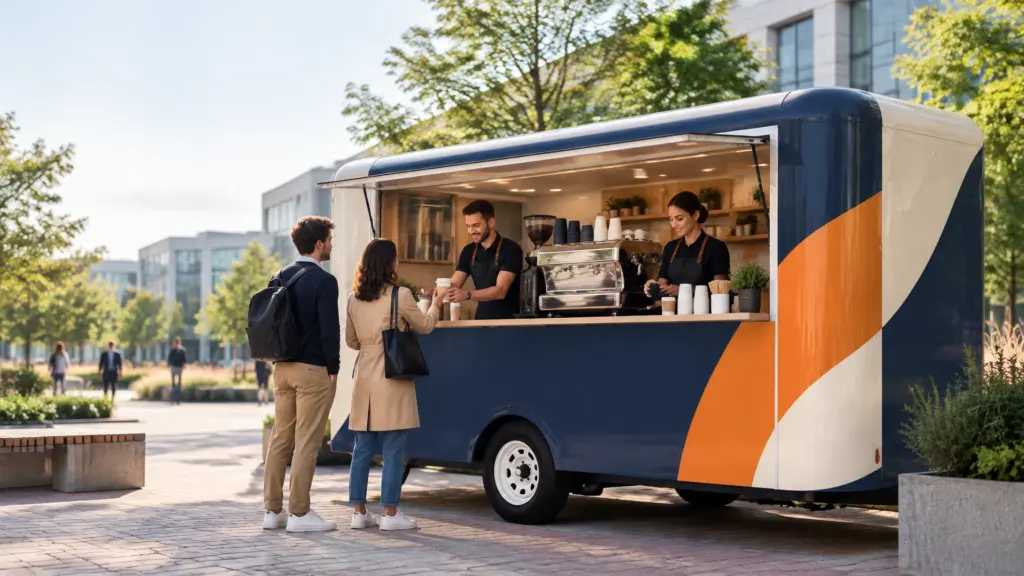
A typical 20-foot coffee layout places the service window along the long side of the unit. The espresso machine and grinders sit near the window so baristas can maintain customer visibility while working. Refrigeration and milk storage should remain within easy reach, while dry storage can use overhead shelving without obstructing movement.
A practical workflow separates the unit into three operating zones:
- Hot zone: espresso machine, hot-water equipment, and beverage preparation.
- Cold zone: milk, juices, pastries, ice, and refrigerated ingredients.
- Wet zone: handwashing, warewashing, water heating, and wastewater management.
A rear staff door can improve loading and emergency access. It is also useful to keep the customer queue outside the work area rather than designing for indoor customer circulation.
For operators comparing coffee trailers near me, the most important question is not which unit looks largest. It is whether two employees can receive an order, prepare it, retrieve ingredients, and hand it to the customer without crossing paths repeatedly.
What power options are available, including battery power?
Coffee equipment can create a significant electrical load. Espresso machines alone may require several kilowatts, while refrigeration, grinders, water heaters, lighting, HVAC, POS equipment, and cooking appliances add to the demand.
The design process should begin with an appliance schedule that records:
- Voltage and wattage
- Dedicated circuit requirements
- Startup or surge loads
- Expected simultaneous use
- Daily operating hours
Shore power
Shore power is usually the simplest option for a semi-permanent site with reliable electrical service. It reduces fuel handling and may be quieter than a generator. The electrical service must still be sized by a qualified professional and approved according to local requirements.
Generator power
A generator can support events and sites without utility access. However, operators should consider sound, fuel storage, emissions, maintenance, and local fire regulations. Generator placement can also affect customer experience and neighboring businesses.
Battery power
Battery systems are increasingly relevant to mobile food kiosks and urban vending. They can reduce noise, provide backup during short outages, and support lower-demand equipment such as lighting, POS systems, and refrigeration.
A fully off-grid coffee operation is more demanding. Running an espresso machine, water heater, refrigeration, HVAC, and other equipment for several hours may require substantial battery storage and a properly sized inverter. The exact requirement depends on the equipment package and operating schedule, so battery capacity should be calculated by an electrical professional rather than estimated from the trailer size.
Pourter’s product development includes lithium-ion battery-powered trailer platforms. Its Urban Food Trailer collection lists compact units with plumbing, electrical systems, service windows, storage, and configurable layouts. That approach can be useful when the goal is to achieve battery-supported mobility without carrying the weight and structural complexity of a steel container.
What permits does a container coffee unit need?
Permitting varies by city, county, state, site classification, and mobility plan. A container mounted on a road-legal trailer may be reviewed differently from a container placed on a foundation or connected permanently to site utilities.
Potential approvals include:
- Building and structural permits
- Electrical and plumbing permits
- Health department approval
- Fire marshal review
- Zoning and land-use approval
- Mobile-vendor licensing
- Trailer or commercial-vehicle registration
- Accessibility review
- Commissary or wastewater documentation
Cutting a large service opening into a container can affect its structural integrity. Engineering drawings may be required, particularly when the unit is modified for doors, windows, equipment, or permanent site connections.
In Austin, operators should review the Texas Department of State Health Services mobile food vendor requirements. The state’s mobile food vending permit now plays a central role in health approval, while local zoning, placement, and fire-safety requirements may still apply.
In New York City, operators should confirm current requirements with the NYC Department of Health and Mental Hygiene. Mobile food vending licensing, unit permits, commissary arrangements, street-placement rules, and borough-specific considerations can all affect the launch schedule.
If you are researching a food trailer near me, contact the relevant authorities before finalizing the build. Permit requirements can influence the plumbing plan, equipment selection, service window, ventilation, and even the unit’s legal classification.
How much does a mobile container coffee unit cost?
Cost tiers vary widely, but a useful planning framework is:
- Basic shell and limited fit-out: approximately $25,000–$60,000 before a complete equipment package.
- Professional 20-foot coffee unit: approximately $75,000–$150,000 with engineering, utilities, finishes, and commercial equipment.
- High-spec or semi-permanent installation: approximately $150,000–$200,000 or more, especially with advanced power systems, premium interiors, transport, site work, and extensive branding.
The steel container itself is only one part of the investment. Budget for structural modifications, insulation, interior finishes, electrical service, plumbing, sinks, water tanks, wastewater management, refrigeration, espresso equipment, permits, transport, installation, and contingency.
A clear equipment schedule and site plan will produce a more useful budget than a low advertised shell price.
How does a container unit compare with a purpose-built custom trailer?
A container-style unit can create a strong architectural presence. It may feel more like a permanent café, offer generous ceiling height, and work well in a business park, campus, redevelopment project, or long-term event location.
A purpose-built coffee trailer is engineered around road travel from the beginning. It generally offers:
- Easier towing and relocation
- More efficient weight distribution
- Integrated chassis and utility systems
- Faster setup at multiple sites
- A simpler path to a fully branded exterior
- Layouts designed specifically for mobile service
Pourter’s Classic and Vintage trailers provide a more distinctive branded profile, while its bar and beverage trailers can support beverage-led concepts beyond coffee. A purpose-built unit can also be developed as a mobile bar, café, concession trailer, or multi-use beverage platform.

The decision comes down to operating model. Choose the container approach when the unit will stay in one area for extended periods and the architectural presence is valuable. Choose a custom trailer when frequent moves, event service, towing efficiency, and faster deployment matter most.
Where can these units work in the United States?
Austin
Austin’s active food, beverage, technology, and event markets create opportunities for coffee units at office campuses, mixed-use developments, markets, and private commercial properties. Operators should coordinate state health permitting with local placement, zoning, and fire-safety requirements.
New York City
New York City offers dense foot traffic and strong demand for convenient coffee, but its permitting and vending environment requires careful preparation. A compact, quiet, professionally branded unit may be well suited to approved private sites, events, and commercial developments.
Whether you are searching for custom food trailers near me in Austin, New York City, Grand Rapids, or another market, begin with the site and permitting plan. The best mobile concept is one that can operate legally, efficiently, and consistently at the locations where customers already gather.
What should you do before starting the build?
Use this checklist:
- Define the menu and expected daily volume.
- Select a 10-foot, 20-foot, 40-foot, or trailer-based format.
- Map equipment, staff positions, customer flow, and storage.
- Calculate electrical loads and compare shore, generator, and battery options.
- Confirm health, zoning, building, fire, plumbing, and mobile-vendor requirements.
- Build a complete budget that includes transport and contingency.
- Review branding, service-window placement, lighting, and customer visibility.
- Choose a builder with experience in mobile food and beverage operations.
Pourter’s design and build process brings planning, layout, branding, construction, delivery, and training into one coordinated project. For operators comparing a container installation with a purpose-built coffee trailer, that early design conversation can clarify the best balance of mobility, capacity, cost, and brand presence.
A container-inspired concept may be the right answer. In many cases, however, a purpose-built mobile unit delivers the same café identity with a more efficient path to the road.