
Key Takeaways
- A weekday-only mobile food operation can serve corporate campuses, hospitals, universities, and office parks with breakfast, coffee, lunch, and grab-and-go menus.
- A written location agreement should define service hours, placement, utilities, insurance, restroom access, storage, site fees, and revenue expectations.
- Staffed units offer broader menus and stronger brand interaction, while self-service models extend availability with lower labor requirements.
- Battery power is especially valuable for indoor lobbies and buildings where generators, propane, noise, or exhaust are not permitted.
- A practical planning range for a solid weekday site is approximately $800 to $1,500 in gross daily sales, although traffic, menu, operating hours, and contract structure can move results significantly.
Meta description: Learn how mobile food kiosks can generate weekday revenue on corporate campuses, hospitals, universities, and office parks through smart site agreements, daypart planning, battery power, and efficient service models.
INTRODUCTION
Mobile food kiosks, a fast-growing format for flexible institutional food service, are giving corporate campuses, hospitals, universities, and office parks a practical alternative to expanding fixed cafeterias. The model brings a professional food or beverage concept directly to the people already working, studying, visiting, or receiving care on-site.
For operators, the opportunity is more than a parking space. A well-positioned unit can create a dependable weekday sales channel, test a new market, extend an existing restaurant brand, or establish a new coffee, lunch, or specialty beverage concept without the cost of a second brick-and-mortar location.
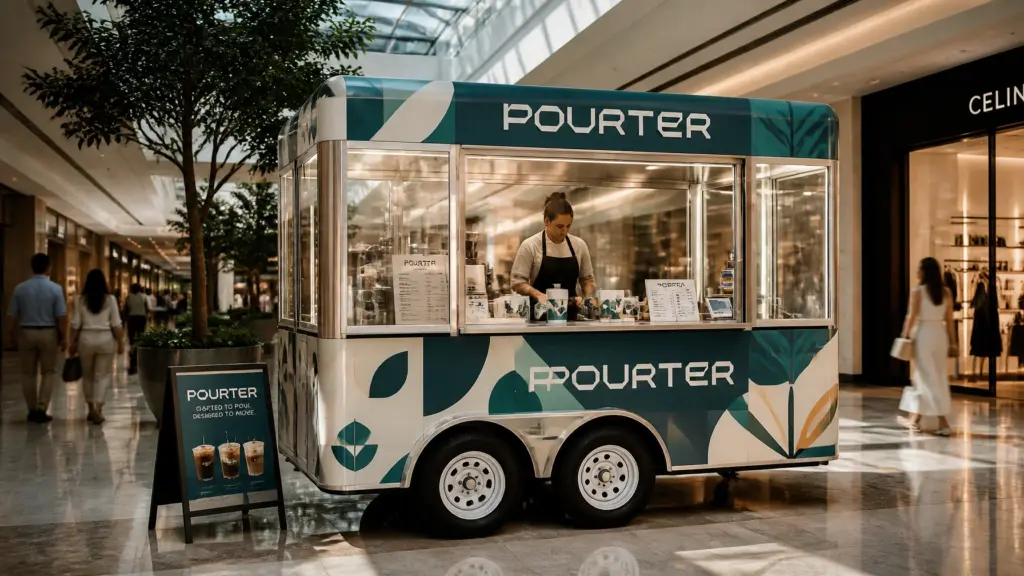
Pourter builds custom food trailers and mobile retail units around that opportunity. Its compact Urban trailer collection is designed for efficient layouts, integrated plumbing and electrical systems, service windows, storage, and adaptable food or beverage workflows.
How should mobile food kiosks be planned for weekday demand?
The strongest campus programs begin with the operating schedule rather than the equipment list. Corporate and institutional locations typically have predictable weekday traffic, but that traffic changes substantially by hour.
A basic daypart plan might include:
- Breakfast: 7:00–9:30 a.m.
- Mid-morning coffee: 9:30–11:00 a.m.
- Lunch: 11:00 a.m.–2:00 p.m.
- Afternoon service: 2:00–4:00 p.m., depending on the site
Breakfast usually favors coffee, tea, breakfast sandwiches, pastries, yogurt, fruit, and other items that can be served quickly. Lunch can support a higher average ticket through bowls, tacos, sandwiches, salads, hot entrees, or rotating menus.
A coffee trailer may generate steady morning traffic and remain operational with a relatively compact menu. A lunch-focused food trailer may produce a higher average transaction but require more equipment, preparation, labor, and power. The right choice depends on the site’s existing food options and the gaps employees or visitors still need filled.

What should a location agreement include?
A location agreement protects both the property owner and the operator. It should be treated as an operating document, not merely permission to park.
At minimum, define:
- Exact placement: Identify the building entrance, courtyard, loading area, plaza, or interior lobby where the unit will operate.
- Service schedule: List operating days, breakfast and lunch hours, setup time, breakdown time, and holiday exceptions.
- Financial terms: Clarify rent, a daily site fee, revenue share, minimum sales commitments, or a hybrid arrangement.
- Utilities: State whether the property provides electrical service, water access, waste collection, or storage.
- Customer access: Confirm pedestrian routes, queue space, delivery access, and ADA considerations.
- Insurance and compliance: Identify required certificates, permits, inspections, vendor approvals, and campus safety documentation.
- Restroom access: Name the facility available to staff and establish reasonable access during operating hours.
- Exclusivity: If appropriate, define whether another coffee, lunch, or beverage vendor can operate nearby.
- Performance review: Set a 60- or 90-day review period to evaluate sales, traffic, customer feedback, and service speed.
For a hospital or university, the agreement may also need rules for patient areas, visitor circulation, infection control, food allergens, and emergency access. Office parks may focus more heavily on parking, employee communications, and tenant expectations.
Do operators need commissary and restroom access?
In most markets, mobile food operators should plan for a licensed commissary or approved commercial kitchen. The commissary can support bulk preparation, cold and dry storage, potable water, waste disposal, equipment cleaning, and inventory management.
The mobile unit should be designed for finishing and service rather than attempting to perform every preparation task on-site. This reduces congestion, improves consistency, and helps the operator maintain a clear separation between production and customer-facing work.
Restroom access is equally important. The operator should not assume that a nearby office or hospital facility will be available without written approval. The location agreement should identify the restroom, access hours, key or badge requirements, and any building policies that apply to staff.
This planning is especially important for a weekday-only operation. A unit may be on-site five days a week, but the operator still needs a repeatable process for replenishment, cleaning, waste handling, and staff breaks.
Should the model be self-service or staffed?
The best choice depends on the menu, site traffic, and the property’s operating objectives.
Staffed service
A staffed unit is usually the stronger choice when the concept depends on:
- Fresh preparation or finishing
- Custom orders
- Hot food
- Hospitality and personal service
- Brand storytelling
- A broad or rotating menu
Staff create a visible presence and can adjust production based on demand. They also help the unit function as a true brand experience rather than a simple transaction point.
The tradeoff is labor. Operators must schedule trained employees, manage breaks, maintain service speed, and account for payroll during slower periods.
Self-service service
A self-service model can work well for:
- Packaged meals
- Refrigerated grab-and-go items
- Snacks and drinks
- Coffee dispensing
- Prepared breakfast products
- Secondary buildings or extended-hour locations
Self-service can reduce labor and make products available outside conventional lunch hours. It may also suit hospitals and universities where demand continues after a staffed unit closes.
However, self-service requires careful attention to refrigeration, payment connectivity, replenishment, cleaning, theft prevention, accessibility, and customer support. A hybrid plan can be effective: a staffed unit during breakfast and lunch, supported by self-service equipment for early morning, late afternoon, or overnight demand.
When is battery power useful indoors?
Battery power can significantly expand the locations available to a mobile food or beverage operator. Corporate lobbies, convention areas, hospitals, museums, and university buildings often restrict generators, propane, exhaust, or excessive noise.
Pourter’s battery-powered food cart guidance explains how quiet, fume-free equipment can support indoor service. The company’s Urban units are also described as lightweight and compatible with lithium-ion battery systems for selected applications.
Battery planning should begin with a load calculation. Lighting, refrigeration, point-of-sale equipment, small appliances, and beverage systems may be suitable for battery operation. High-load cooking equipment, commercial espresso equipment, induction cooking, and heating systems may require shore power or a larger engineered power package.
The location agreement should specify:
- Available amperage and outlet type
- Charging access
- Battery recharge timing
- Backup power procedures
- Fire and building approval
- Equipment noise limits
- Whether the unit will move between locations
Battery power is not automatically the right answer for every menu. It is a design option that should be matched to the equipment package and the building’s rules.
What revenue can a weekday-only operation expect?
Revenue expectations should be modeled as a range rather than a promise. Industry benchmarks for food trucks, coffee service, institutional contracts, and self-service food equipment suggest that a solid weekday campus site may produce approximately $800 to $1,500 in gross sales per operating day.
A simple example:
- Breakfast and coffee: 70 transactions at a $7 average = $490
- Lunch: 100 transactions at a $11 average = $1,100
- Afternoon beverages or snacks: 25 transactions at a $5 average = $125
- Illustrative daily gross sales: $1,715
That example represents a mature, well-positioned site, not a guaranteed result. A smaller location may generate $600 to $900 per day, while a high-traffic corporate campus, hospital, or university can exceed $1,500 during strong operating periods.
Operators should track:
- Transactions by daypart
- Average ticket
- Service speed
- Product waste
- Labor cost
- Commissary and delivery cost
- Site fees or revenue share
- Weather and academic calendar effects
- Repeat purchase rate
Lunch often provides the largest revenue opportunity, while breakfast and coffee can establish daily habits. A concept that captures both dayparts may produce more stable weekday revenue than one built around lunch alone.
For broader context on mobile retail planning, Pourter’s guide to building a mobile pop-up shop covers footprint, battery systems, permitting, branding, and technology.
Where can operators find demand near me?
Search behavior often begins with phrases such as “mobile food kiosk near me,” “food trailer near me,” or “coffee trailers near me.” For operators, those searches point to an important business principle: visibility and proximity matter as much as the menu.
In Austin, a university-adjacent unit could serve students and faculty during breakfast and lunch, while a corporate office park concept could focus on coffee, tacos, bowls, or fast casual meals. The city’s mix of technology employers, campuses, and event traffic supports flexible mobile formats.
In New York City, a corporate lobby, hospital campus, or university building may offer a more practical placement than a traditional street location. Indoor approvals, building access, power, and queue management become central to the operating plan. A property manager searching for a mobile food kiosk near me may be evaluating safety, design, and reliability alongside food quality.
Other strong targets include Chicago, Atlanta, Dallas, Denver, Boston, and Seattle. The best market is the one where the operator can secure a repeatable site, reach a defined audience, and serve at the hours when demand is concentrated.
How does Pourter support a campus-ready build?
Pourter approaches each unit as a combination of equipment, workflow, and brand environment. Its Classic Vintage collection offers a distinct visual direction, while the bar and beverage trailer collection can support coffee, beverage, hospitality, and mobile bar concepts.
For a campus or office-park installation, key design priorities include:
- Efficient movement between storage, preparation, and service
- Durable, cleanable interior finishes
- Integrated plumbing and electrical systems
- Sufficient refrigeration and dry storage
- Clear menu and payment visibility
- Rounded, polished exterior lines
- Full-unit branding rather than a small logo application
- A layout suited to the site’s doorways, loading areas, and customer queue
A professionally built unit can function as a food trailer, coffee trailer, concession trailer, branded retail point, or mobile bar depending on its equipment and intended use. That flexibility gives existing restaurants, entrepreneurs, and multi-unit operators more ways to test weekday demand before committing to permanent construction.
What is the next step?
Start with the site, not the trailer. Document pedestrian counts, employee schedules, existing food options, building rules, available power, restroom access, delivery routes, and the property owner’s preferred agreement structure.
Then match the menu and operating model to the dayparts. A coffee-forward concept may need less cooking equipment but stronger morning placement. A lunch concept may need more power, labor, and prep support. A hospital may benefit from hybrid availability, while a corporate campus may prioritize a polished staffed experience.
When the operational requirements are clear, Pourter can help translate them into a branded mobile unit designed for the location, the customer, and the weekday revenue objective.

Frequently Asked Questions
Are mobile food kiosks profitable on corporate campuses?
They can be, particularly when the operator has a defined audience, predictable weekday traffic, a disciplined menu, and a workable location agreement. Gross revenue does not equal profit, so labor, food cost, commissary expenses, site fees, insurance, maintenance, and financing must be included in the financial model.
Can a coffee trailer operate inside an office building?
Potentially, if the building permits the equipment, the unit can access the space, and the operator satisfies fire, health, electrical, insurance, and property requirements. Battery power may help where generators or fuel systems are not allowed.
What is the difference between a concession trailer and a custom food trailer?
A concession trailer is often a standardized format for selling food or beverages. A custom food trailer is configured around a specific menu, workflow, brand identity, equipment package, and operating environment.
How do I find custom food trailers near me?
Begin by identifying manufacturers that publish real product details, explain their design and build process, and can address state-specific compliance. Review Pourter’s process page and product collections before requesting a concept or quote.