
Key Takeaways
- Recurring contracts can make beverage service more predictable than one-off event rentals.
- Corporate happy hours, hotel partnerships, taproom pop-ups, catering add-ons, and brand activations each support different pricing structures.
- Capacity planning should account for guest volume, menu complexity, staffing, refrigeration, draft systems, and service time.
- Battery-powered units can support quiet, off-grid placements when the electrical load is designed correctly.
- Licensing depends on state ABC rules, local permits, alcohol ownership, and whether the operator is selling or simply providing service.
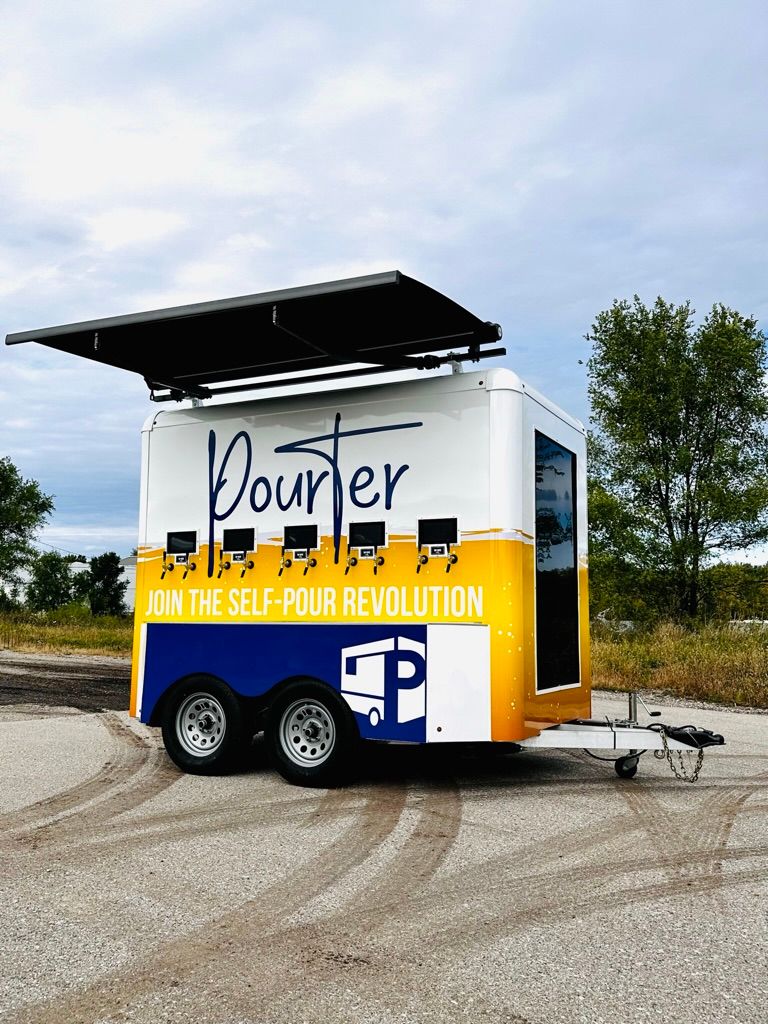
- Pourter builds branded beverage trailers with flexible layouts, battery power, modern finishes, and full-unit graphics.
INTRODUCTION
A mobile bar, a flexible hospitality platform for restaurants, caterers, beverage brands, and hospitality groups, can generate substantially more value than a series of isolated event rentals. The strongest operators treat the unit as a recurring sales channel: a branded service point that returns to the same office, hotel, taproom, campus, or retail destination on a reliable schedule.
That shift changes the business model. Instead of waiting for the next wedding or private party, owners can sell monthly retainers, preferred-vendor agreements, sponsored sampling programs, and seasonal residencies. A well-designed bar and beverage trailer from Pourter can support those opportunities while presenting the same professional identity as an established brick-and-mortar business.

1. How can recurring corporate happy hours create stable revenue?
Corporate offices increasingly use food, beverage, and hospitality programming to support employee engagement, recruiting, client entertainment, and workplace culture. A beverage operator can turn that demand into a weekly, biweekly, or monthly service agreement.
A basic package might include two hours of service, beer and wine, nonalcoholic options, mixers, ice, setup, and cleanup. Higher tiers can add signature cocktails, custom menus, branded cups, upgraded staffing, or seasonal menus.
Illustrative pricing structures include:
- A monthly retainer for one scheduled service date.
- A four-event package with a defined guest limit.
- A base service fee plus a per-person overage.
- A minimum spend that covers staffing, transportation, and ingredients.
As a planning benchmark, an operator might build around $1,200 to $2,000 in revenue per corporate service date, then adjust for guest count, alcohol costs, labor, travel, and the complexity of the menu. The goal is not to copy a market average; it is to create a package with a clear contribution margin.
2. How do hotel and resort partnerships produce repeat bookings?
Hotels, resorts, conference centers, and private clubs often need flexible beverage service for lawns, rooftops, pool decks, courtyards, wedding venues, and off-property events. A permanent bar may not fit every space, while a polished trailer can be deployed where the guest experience requires it.
Common partnership structures include:
- A preferred-vendor agreement.
- A fixed availability or on-call fee.
- A net rate that the hotel marks up for the client.
- A commission arrangement for bookings generated through the property.
- A seasonal residency at a pool, garden, golf course, or event lawn.
The contract should define who supplies the alcohol, who holds the permit, how gratuity is handled, and whether the hotel or operator is responsible for staffing and cleanup. The unit also needs to match the property’s design standards. Pourter’s Classic and Vintage collection offers a polished visual direction, while the Next-Gen collection supports premium finishes, full branding, and integrated technology.
3. How can breweries and distilleries turn pop-ups into a regular calendar?
Breweries, distilleries, wineries, and cider houses already have an audience. A recurring mobile beverage program can help them reach customers beyond the taproom or add a new service format to existing locations.
Potential arrangements include:
- A first-Friday cocktail or tasting series.
- A branded satellite bar at markets and festivals.
- A release-party service package.
- A co-branded cocktail menu using the producer’s products.
- A revenue share or guaranteed minimum for each appearance.
Long Road Distillers in Grand Haven, Michigan, is one example of a beverage business using a custom unit to extend its presence into a social zone. Pourter’s project page shows how a purpose-built unit can support a branded service environment outside a conventional tasting room.
The unit should be designed around the product format. Draft beer requires different refrigeration and line management than cocktails, wine, spirits, or ready-to-drink products. Self-pour technology may also support faster service, but operators must confirm that the system fits local licensing and responsible-service requirements.
4. How can existing caterers add beverage service without opening another venue?
Caterers already have relationships with corporate planners, wedding venues, event producers, and private clients. Adding a dedicated beverage unit can increase average order value without requiring a second permanent location.
A caterer can offer:
- Beverage service as an add-on to food packages.
- A custom cocktail station for weddings.
- A coffee trailer for morning meetings and conferences.
- A concession trailer for large public events.
- Nonalcoholic beverage service for schools, campuses, and family events.
The important distinction is operational clarity. The caterer should price the unit separately from food production, then account for transportation, setup, staffing, glassware, ice, garnishes, refrigeration, and cleanup.
For businesses comparing custom food trailers, custom food trucks, and beverage-specific builds, service flow matters more than appearance alone. A unit that looks attractive but lacks storage, refrigeration, or an efficient handoff point can reduce margins at high-volume events.
5. How do brand activations and sponsored sampling improve margins?
Beverage brands often need more than a table and a cooler. They need a controlled, recognizable environment for sampling, storytelling, data capture, and social content. A custom bar trailer can become the physical centerpiece of that campaign.
Revenue can be structured as:
- A daily activation rate.
- A production fee for staffing, logistics, and installation.
- A branding fee for wraps, signage, menus, and display panels.
- An ingredient and consumables charge.
- A multi-city tour rate.
- A content or photography add-on.
The sponsor may provide the product, but that does not eliminate the operator’s costs. Labor, transportation, permits, refrigeration, ice, cups, waste handling, and storage should remain visible in the quote.

Pourter’s article on brand activation ideas for mobile retail units explains why full-unit graphics and integrated technology can make the trailer part of the campaign itself rather than just a service counter.
6. Can office memberships and subscriptions create predictable volume?
A membership model works when a group receives recurring access to a defined service. For offices, coworking spaces, apartment communities, and private clubs, that could mean a scheduled beverage program every week or month.
Possible tiers include:
- Essential: one service date per month, limited menu, up to 50 guests.
- Growth: two service dates, expanded menu, and up to 100 guests.
- Premium: weekly service, custom cocktails, branded menus, and priority scheduling.
Capacity should be written into every agreement. One bartender may handle a simple beer-and-wine menu for approximately 35 to 50 guests, while cocktail-heavy service requires more staff and preparation. A 100-person service may need two or more bartenders depending on the menu, speed, and number of service points.
Subscriptions should also include cancellation terms, weather policies, holiday scheduling, guest overages, and ingredient changes. Predictable volume is valuable, but only if the contract protects labor and travel costs.
7. What are venue residencies and seasonal placements?
A seventh model is the semi-permanent placement: a unit stationed at a recurring destination for a season or a defined series of dates. Examples include a beverage trailer at a sports complex, a shopping district, a mixed-use development, a golf course, or a summer concert venue.
Pricing may combine:
- A weekly or monthly site fee.
- A guaranteed minimum payment from the property.
- A percentage of sales.
- A fixed service rate for private bookings.
- Sponsorship revenue from a beverage partner.
This model rewards durable construction, efficient storage, reliable power, and a full-unit design that remains attractive throughout the season. Pourter’s Urban collection is positioned as a compact, customizable platform with plumbing, electric, storage, service windows, and lithium-ion battery power. Published starting prices and specifications can change, so operators should confirm the current configuration during the design process.
How should a mobile bar business plan for capacity and battery power?
Capacity planning begins with service volume, not the trailer’s exterior dimensions. Estimate peak guests per hour, menu complexity, number of taps or wells, refrigeration requirements, storage, water, waste, and staff movement.
For off-grid placements, create an equipment load schedule before ordering the unit. Refrigeration, draft systems, POS equipment, lighting, pumps, and small appliances all draw power. A small setup may be designed around a few kilowatt-hours of usable battery capacity, but the correct specification depends on runtime, ambient temperature, equipment startup loads, and recharge access.
Pourter’s battery-powered approach is especially relevant for indoor venues, hotel lobbies, convention centers, and noise-sensitive activations. Its guidance on battery-powered carts for indoor events highlights the benefits of quiet, fume-free operation. Always confirm venue power requirements, fire-safety rules, and the final electrical design with the builder and local authorities.
Where can operators launch a recurring beverage program?
Location affects both demand and compliance. In Chicago, an operator may pursue corporate campuses, hotel rooftops, breweries, and summer event districts. In Austin, recurring opportunities may include tech offices, distilleries, music venues, apartment communities, and outdoor hospitality spaces. New York, Dallas, Nashville, and Miami offer additional markets, but each has distinct local permitting and alcohol rules.
Search intent often begins with phrases such as “mobile bar near me,” “custom bar trailer near me,” or “food trailer near me.” For operators, those searches point to a larger opportunity: a unit that can serve multiple revenue channels while remaining recognizable and professionally branded.
What licensing basics should owners understand?
Alcohol regulation is state-specific. Most operators must work with the state Alcoholic Beverage Control agency or equivalent, then confirm city and county requirements for each site.
Before serving alcohol, clarify:
- Whether a retail or on-premise license is required.
- Whether a caterer’s endorsement or temporary event permit applies.
- Who purchases and owns the alcohol.
- Whether the venue needs its own permit.
- Whether health permits apply to juices, garnishes, or food service.
- What general liability, liquor liability, and commercial auto coverage is required.
- How age verification, responsible service, taxes, and reporting will be handled.
Michigan, for example, publishes specific guidance on private events, bartending services, and food trucks. It is a useful reminder that a general assumption about licensing may not apply in another state. Confirm the rules before signing a recurring contract.
What should an owner look for in a custom bar trailer?
A successful unit must support the business model, not only the visual concept. Evaluate towing weight, service windows, refrigeration, draft equipment, storage, water and waste systems, battery capacity, staff circulation, branding surfaces, and future menu changes.
A search for food trailers for sale may reveal generic inventory, but recurring beverage work usually benefits from a purpose-built layout. Pourter’s manufacturing process supports custom configurations for hospitality, retail, beverage, and brand activation applications. The result can be a flexible asset that serves corporate offices one week, a distillery pop-up the next, and a hotel residency after that.
The strongest recurring-revenue strategy combines several models rather than relying on one. Corporate subscriptions can stabilize the calendar, hospitality partnerships can add volume, taproom pop-ups can build community, and sponsored activations can improve peak-season margins. With the right licensing, capacity plan, battery system, and custom design process, a beverage unit can become a dependable growth platform rather than a seasonal rental expense.
SEO Fields
- Focus keyword: mobile bar
- SEO title: Beyond Event Rentals: 7 Recurring Revenue Models for Mobile Bar Units
- Meta description: Explore seven recurring revenue models for a mobile bar, including corporate happy hours, hotel partnerships, taproom pop-ups, subscriptions, and brand activations.