
SEO title: Coffee Shops Going Mobile: Custom Food Trailers, Carts, and Café Expansion
Meta description: Learn how established cafés can add a coffee trailer, cart, or kiosk while protecting the home store, simplifying menus, managing staffing, and testing demand.
Focus keyword: custom food trailers
Key Takeaways
- A mobile unit can create a second revenue stream without requiring a second full café lease.
- Protect the home store by assigning the mobile operation its own staffing plan, menu, inventory, and performance targets.
- Start with a concise menu built around drinks that are fast to prepare and easy to replicate.
- Choose a battery-powered cart for a controlled pilot, a trailer for higher volume, or a semi-permanent kiosk for an anchor location.
- Use the same colors, typography, packaging, uniforms, and full-unit wrap graphics across the storefront and mobile unit.
- Pilot the concept for 60 to 90 days before investing in a larger build.
INTRODUCTION
An established brick-and-mortar coffee shop, a neighborhood staple and a trusted daily destination, already has the most important foundation for mobile growth: a proven product, trained employees, and an existing customer base. The next step is not necessarily another lease. For many cafés, a carefully planned custom food trailers strategy can add revenue at offices, campuses, festivals, markets, hospitals, and private events while keeping the home store focused on its core customers.
The challenge is operational rather than conceptual. A mobile unit should extend the café’s reach without pulling its strongest baristas away from the counter, creating inconsistent drinks, or turning the brand into two disconnected businesses. The best expansion plans treat the cart or trailer as a second channel with shared standards and distinct responsibilities.
Why should a café add a mobile unit instead of opening another store?
A cart or coffee trailer gives an established café access to new traffic patterns without the fixed costs of a traditional location. It can reach customers near an office park during the morning commute, serve an outdoor event on the weekend, or operate as a catering and brand-activation vehicle between scheduled appearances.
The mobile format also creates a practical testing ground. A café can measure demand in a new neighborhood before signing a lease, test seasonal drinks without changing the permanent menu, and build awareness in a market where customers may not yet know the original location.
This approach is especially useful for businesses searching online for coffee trailers near me or exploring food trailers near me as a way to enter new territories. A mobile unit can validate the location before a larger investment follows.
The home store remains the operational anchor. It can handle prep, inventory purchasing, training, marketing, and administrative work while the mobile unit creates an additional point of sale.
How can owners staff the mobile unit without weakening the home café?
Staffing should be designed before the build begins. The mobile unit needs a defined labor model rather than an informal arrangement in which the home store sends whoever is available.
For a small cart, one cross-trained barista may be sufficient during lower-volume service. A trailer serving a busy office district or event may require a lead barista, a support person, and a dedicated cashier or runner. The right model depends on expected volume, service hours, equipment, and menu complexity.
A practical staffing plan includes:
- A fixed weekly schedule for the mobile unit
- A designated lead responsible for setup, service, and closeout
- Cross-training for at least two backup employees
- Separate labor targets for the storefront and mobile operation
- Clear rules for when the mobile unit pauses service because the home store needs support
Rotating employees can be useful, but the schedule should protect peak periods at the original café. Mobile shifts may fit best during slower afternoons, weekends, or pre-booked events. Over time, the mobile operation may justify a dedicated team.
The goal is not simply to move staff from one location to another. It is to create a repeatable operating system that helps employees perform consistently in both environments.
What should a mobile coffee menu include?
A mobile menu should be smaller than the home café’s menu. That is not a limitation; it is a service advantage. Fewer choices make ordering faster, reduce inventory complexity, and help every barista reproduce the same drink.
A strong starting menu might include:
- Espresso
- Americano
- Latte
- Cappuccino
- Cold brew
- Two or three signature drinks
- One seasonal special
- A small selection of pastries or packaged food
The menu should reflect the café’s identity while prioritizing speed. Recipes need exact specifications for espresso yield, milk volume, syrup portions, ice, garnish, and cup size. Digital recipe cards, calibrated grinders, labeled containers, and regular taste checks can help preserve quality across both locations.
The mobile operation is also a useful place to test a signature drink. Track drinks sold, preparation time, average ticket, waste, and repeat demand. If an item performs well on the trailer, it can move into the storefront’s permanent or seasonal menu. If it is slow or difficult to execute, the business can remove it without disrupting the full café.
A shared point-of-sale system makes the comparison easier. Owners can see whether the mobile unit is generating incremental sales or simply shifting existing customers from the home store.

Should a café choose a battery-powered cart, a trailer, or a kiosk?
Each format serves a different expansion objective.
Battery-powered cart: best for a controlled pilot
A battery-powered cart works well for indoor events, corporate offices, hotel lobbies, campuses, and other locations where quiet operation and a compact footprint matter. It can be easier to deploy than a trailer and may allow a café to test several locations with less logistical commitment.
Before selecting a cart, confirm the equipment load, charging plan, water requirements, service hours, and venue rules. Espresso machines, grinders, refrigeration, lighting, and point-of-sale equipment all need to work together reliably.
Pourter’s guide to integrating a brand into indoor events with battery-powered food carts explains why quiet, fume-free mobile units are useful in indoor environments.
Coffee trailer: best for higher volume and broader mobility
A coffee trailer offers more room for refrigeration, storage, water systems, equipment, and staff movement. It is a strong option for recurring events, business districts, food halls, campuses, and high-volume catering.
Pourter’s Urban trailer collection includes compact layouts available in 5-by-10 and 6-by-10 footprints, with plumbing, electrical systems, sinks, counters, service windows, lighting, and storage. The company also describes lithium-ion battery-powered options for quiet, lightweight operation.
For a more distinctive customer-facing presence, the Classic and Vintage trailer collection offers a retro-inspired exterior with modern infrastructure and customizable layouts.
Mobile food kiosk or shipping container café: best for an anchor location
Mobile food kiosks and shipping container cafes are better suited to semi-permanent placements. They can serve as a satellite café at a corporate campus, transportation hub, shopping center, or university while retaining more flexibility than a conventional build-out.
These formats generally require a stronger site commitment, utility planning, and permitting review. They make sense when the café has validated demand and identified a reliable location rather than as the first experiment.
How should the mobile unit match the storefront brand?
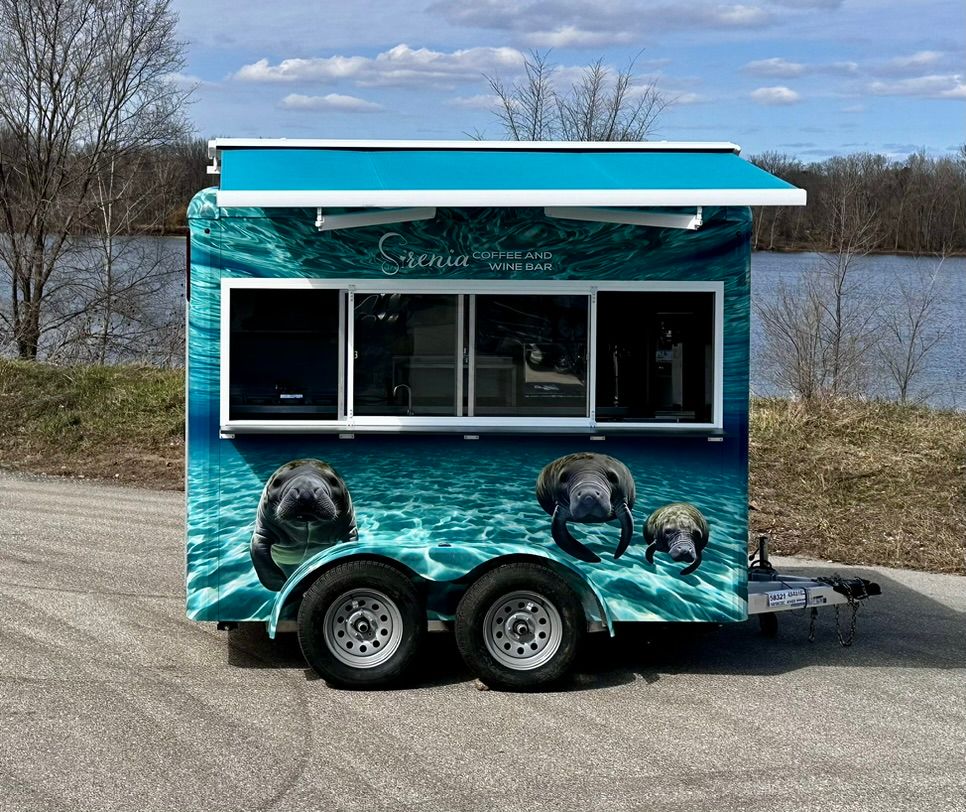
The mobile unit should look like the café moved outdoors, not like an unrelated vendor carrying the same logo. Consistency begins with the full visual system: colors, typography, photography, packaging, uniforms, menu boards, and tone of voice.
A full-unit wrap can turn the trailer into a highly visible marketing asset. It should use the same visual language as the storefront while adapting the design for fast recognition at a distance. Product names, signature colors, and recognizable patterns should be visible from the service line and in customer photographs.
Rounded corners and clean finishes also help the unit feel like a premium extension of a modern café. Pourter’s our process incorporates concept development, design, engineering, and delivery so the operational layout and visual identity can be considered together.
That approach is particularly valuable for cafés using the unit at brand activations. A well-designed trailer can serve drinks, create social content, and introduce the café to customers who may never pass the original storefront.

How can a café pilot mobile service before committing to a full build?
A 60- to 90-day pilot creates a disciplined path from idea to investment.
Begin with a narrow set of locations and operating hours. For example, a café might run weekday mornings at an office campus, one weekly market, and two private events per month. This provides enough variation to compare commuter, community, and event traffic.
Track:
- Transactions per hour
- Average ticket
- Sales by drink
- Wait time
- Labor hours
- Product waste
- Power and water performance
- Repeat customers
- Revenue generated independently of the home store
The pilot should also test the management workload. Someone must handle transportation, setup, permits, inventory, cleaning, maintenance, cash reconciliation, and weather contingencies.
If customers are searching for a food trailer near me, they are often looking for convenience as much as a particular brand. Make the mobile schedule easy to find through the café’s website, Google Business Profile, social media, and email list. Publish reliable locations rather than promising a broad service area that changes constantly.
At the end of the pilot, compare results against clear thresholds. If the unit meets its sales, labor, and service goals, the café can consider a larger trailer, a second unit, or a semi-permanent kiosk.
Where can mobile cafés expand successfully?
Location strategy should reflect the café’s customer profile.
In Austin, a mobile coffee operation may test office districts, weekend markets, creative campuses, and private events before considering a permanent second shop. The city’s event culture can provide a useful mix of recurring and seasonal demand.
In Chicago, a café may focus on corporate campuses, university areas, neighborhood festivals, and indoor venues where a compact or battery-powered unit can operate during colder months. Local regulations, commissary requirements, parking rules, and health approvals must be reviewed before launch.
Whether customers search for coffee trailers near me in Austin or food trailers near me in Chicago, visibility depends on consistent scheduling and clear communication. Owners should also research nearby competitors, foot traffic, event calendars, and the distance between the mobile unit and the home store.
How can owners compare builders and choose the right unit?
Search results for food trailers for sale, food truck manufacturers, custom food trucks, and a concession trailer can produce very different types of businesses and equipment. Café owners should compare more than the exterior appearance.
Ask about:
- Equipment and electrical capacity
- Water and waste systems
- Service-window placement
- Workflow between ordering and handoff
- Battery or shore-power options
- State-specific compliance requirements
- Warranty and service support
- Branding and wrap capabilities
- Delivery and installation
- Future expansion options
Pourter builds units for food, beverage, retail, and brand activation applications. Its bar and beverage trailers can be adapted for café service, specialty drinks, and event-based hospitality, while the broader food trailer collection shows how established brands use mobile units to extend their reach.
For additional planning guidance, cafés can also review Pourter’s complete guide to starting a mobile food business with a custom trailer.
What is the best first step for a café going mobile?
Start with the business case, not the trailer shell. Define the target locations, service hours, staffing capacity, menu, equipment, and pilot metrics. Then work with a builder that can connect those requirements to an efficient layout and a clear brand experience.
A mobile unit should strengthen the home café by creating new customer touchpoints, improving operational learning, and generating revenue in places the storefront cannot reach. With a focused menu, protected staffing plan, consistent branding, and measured pilot, a coffee trailer can become a practical second channel rather than a distraction from the original business.