
INTRODUCTION
Key Takeaways
- Battery-powered food trailers deliver near-silent operation, zero on-site emissions, and lower day-to-day energy and maintenance costs.
- Traditional generators still make sense for remote locations, long festivals, and operators who need lower upfront pricing with extended runtime.
- Urban operators should pay close attention to tightening noise and emissions rules, especially in high-value city placements.
- For brands comparing long-term flexibility, a custom build designed around lithium power can offer a stronger customer experience and better regulatory resilience.
Pourter, a premier manufacturer of high-end custom food trailers, remains at the forefront of the mobile commerce evolution by addressing the critical challenge of power management for entrepreneurs and established brands alike. In the fast-growing industry of mobile food and beverage service, the decision between traditional internal combustion generators and advanced battery power systems has become a cornerstone of operational strategy. As municipalities across the United States implement stricter noise and emission standards, the choice of a power source is no longer merely a technical specification; it is a fundamental component of a brand’s community standing and long-term viability. This transition from fossil-fuel-dependent machinery to sustainable, silent energy reflects a broader movement toward efficiency and environmental responsibility in the modern marketplace.
The Traditional Workhorse: Gas and Propane Generators
For decades, the portable gasoline or propane generator has served as the staple power source for custom food trailers. Its primary appeal lies in its immediate availability and relatively low upfront cost. A high-quality internal combustion engine (ICE) generator can provide a high surge capability, which is essential for powering heavy equipment such as espresso machines, commercial refrigerators, and air conditioning units simultaneously.
The most significant advantage of a generator is its effectively unlimited runtime. As long as a vendor has access to fuel, the unit can operate indefinitely. This reliability makes generators a popular choice for vendors operating in remote locations or at multi-day festivals where shore power is unavailable. However, this reliability comes with a physical and operational cost. Generators are inherently noisy, typically operating between 70 and 80 decibels: a volume level that can disrupt the customer experience and lead to conflict with local residents. Furthermore, the requirement for regular maintenance: including oil changes, spark plug replacements, and carburetor cleaning: creates a recurring logistical burden for the business owner.

The Modern Alternative: Battery-Powered Food Trailers
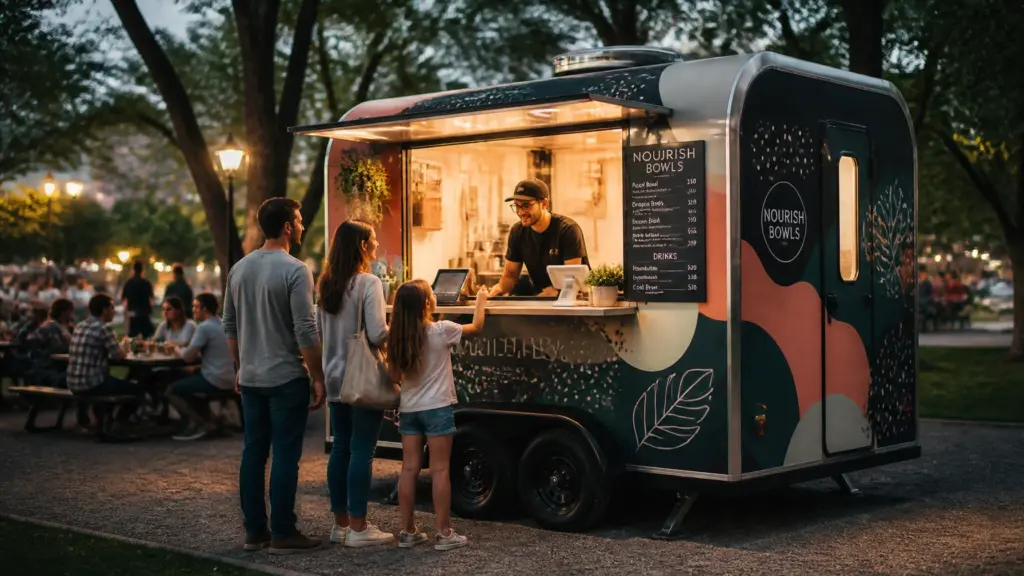
The emergence of the battery powered food trailer represents a transformative shift in the industry. For operators searching for a battery powered food trailer near me, the real advantage is not just quieter equipment, but a fully integrated system built around the demands of city service, premium events, and professional brand presentation. Utilizing high-capacity lithium battery banks paired with high-efficiency inverters, these systems provide a near-silent energy solution that operates below 35 decibels: roughly the volume of a whisper. This silence allows vendors to secure high-value locations, such as residential streets and quiet corporate campuses, where traditional generators are often restricted by noise ordinances.
Beyond the noise reduction, battery systems offer zero on-site emissions. This is a critical factor for brands looking to operate indoors, under pavilions, or in urban centers with strict air quality standards. While the initial investment for a lithium system is higher than that of a generator, the long-term return on investment (ROI) is significant. Electricity from the grid, used to charge the batteries overnight at a commissary or home base, is vastly cheaper than gasoline or propane. Many operators report that their daily energy costs drop to approximately 20% of their previous fuel expenditures, while maintenance costs are virtually eliminated due to the lack of moving parts.

Navigating the Regulatory Landscape
The regulatory environment for mobile businesses is changing rapidly. States like California have already begun phasing out the sale of small off-road engines (SORE), which include many portable gasoline generators. This legislative momentum is mirrored in major metropolitan areas where noise and exhaust complaints lead to frequent fines or the total exclusion of loud vendors from lucrative public parks and plazas.
In cities like New York and Austin, the focus is shifting toward "zero-emission zones." For a food service trailer to be future-proof, it must be designed with these tightening restrictions in mind. A battery-powered system ensures that a business can continue to operate regardless of shifting local bylaws. For buyers comparing custom food trailers near me, that future-proofing increasingly matters as city regulations become less flexible. By adopting these technologies now, entrepreneurs position themselves as leaders in a cleaner, more professional industry, rather than reacting to mandates as they arise.
Operational Impact and Customer Experience
In the hospitality sector, the atmosphere is as important as the product. A loud, vibrating generator placed behind a beautifully designed trailer can undermine the premium feel of a brand. Conversely, a silent operation allows for clear communication between staff and customers, fostering a more personal and welcoming environment. This improved interaction often translates to higher customer satisfaction and increased sales.
Furthermore, the stability of power provided by modern inverters is superior to that of many budget generators. Sensitive electronics, such as modern point-of-sale (POS) systems and digital menu boards, are prone to damage from the "dirty power" and voltage fluctuations common in traditional engines. A dedicated battery system provides a consistent pure sine wave, protecting the sophisticated technology integrated into Pourter’s custom builds.

Choosing the Right Path for Your Custom Build
The decision between a generator and a battery system ultimately depends on your specific business model and operating environment.
- Choose a Generator if: You operate primarily in rural areas, attend long-duration festivals with no access to shore power, and require maximum surge capacity at the lowest possible entry price.
- Choose a Battery System if: You operate in urban settings, residential neighborhoods, or corporate environments; you value a silent customer experience; and you want to reduce long-term fuel and maintenance costs while future-proofing your business against new regulations. For a deeper look at layouts and concepts built for city service, explore Pourter’s urban food trailers page.
Many modern businesses are opting for a hybrid approach: a primary battery system that covers 90% of daily needs, supplemented by a small, super-quiet inverter generator as a backup or for rapid charging during unusually long shifts.

At Pourter, we specialize in engineering custom solutions that match your power requirements with your brand’s goals. Whether you are an entrepreneur launching your first concept or a multi-unit chain restaurant expanding your footprint, our team is equipped to build a unit that is as efficient as it is visually striking. If you want to see how different concepts, finishes, and wraps come together in the field, visit our gallery page. The future of mobile commerce is quiet, clean, and incredibly powerful.