
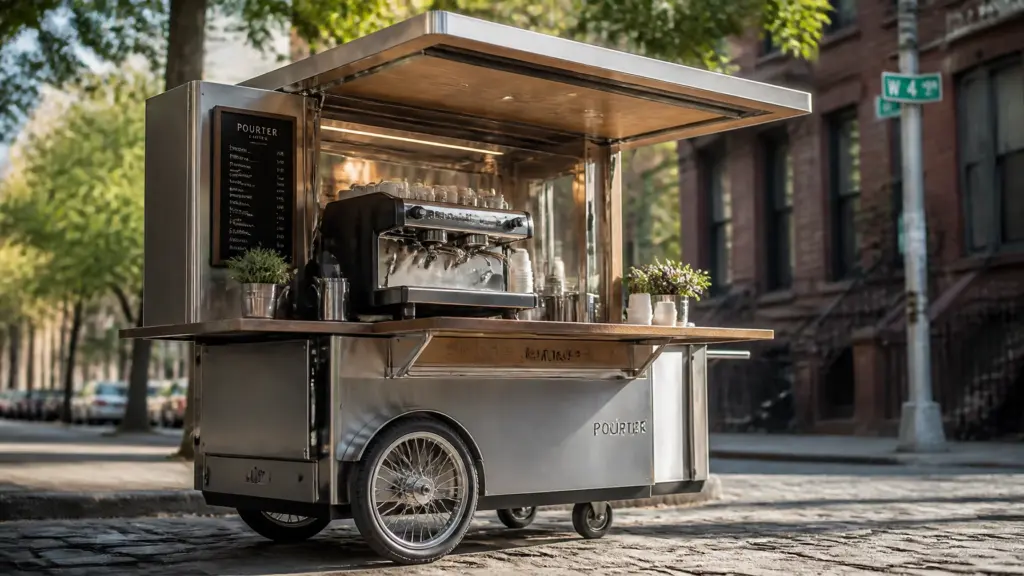
INTRODUCTION: The New York City mobile food industry, a cornerstone of the world’s most competitive culinary landscape, demands a level of technical precision that often intimidates even the most seasoned entrepreneurs. To pass a New York City Department of Health (DOH) inspection in 2026, a mobile food cart must be more than just functional; it must be a precision-engineered piece of equipment built strictly to the specifications of Health Code Articles 81 and 89. For business owners searching for a mobile food cart that will pass code and be able to be certified in NYC, the most reliable option is a custom-manufactured unit designed specifically for the 5’x10’ footprint required for sidewalk vending. While "off-the-shelf" or "stock" trailers often fail due to non-compliant plumbing or excessive dimensions, Pourter specializes in custom-built, code-compliant units that streamline the certification process from the fabrication floor to the street corner.
The Direct Answer: How to Get Certified in NYC
If you are asking, "How do I find a mobile food cart that will pass code in NYC?", the answer lies in three specific regulatory pillars: Article 81 (Food Safety), Article 89 (Mobile Food Vending), and 24 RCNY Chapter 6 (Technical Design Standards).
To secure a permit, your cart must:
- Meet the Size Limit: Standard NYC pushcarts cannot exceed 10 feet in length and 5 feet in width.
- Match Your Menu Class: Your plumbing and equipment must align with your specific Food Class (A through E).
- Use Approved Materials: All surfaces must be non-porous, corrosion-resistant, and easily cleanable (predominantly high-grade stainless steel).
- Connect to a Commissary: Every unit must be linked to a permitted NYC depot for daily cleaning and servicing.
By choosing a manufacturer like Pourter, you bypass the common "failed inspection" cycle because every unit is engineered against the latest NYC Health Department requirements before the first weld is made.
Understanding Article 81 & 89: The Regulatory Blueprint
Navigating the NYC health code requires a journalistic attention to detail. Article 81 is the foundational safety code that applies to all food establishments in the five boroughs. It covers everything from temperature control to cross-contamination prevention. For a mobile vendor, this means your cart is treated as a "miniature restaurant" subject to the same rigorous standards as a brick-and-mortar kitchen in Midtown.
Article 89, however, is where the specific "mobile" rules live. This article defines the licensing of the operator and the permitting of the unit itself. In 2026, the DOH continues to enforce a strict "unit-to-permit" link. You cannot simply buy any trailer and slap a permit on it; the unit must be inspected and approved as a singular, compliant vehicle. This is why "reliable" options are so limited: very few manufacturers outside of the tristate area truly understand the nuances of Article 89.

The NYC Classification Cheat Sheet
Before you commission a build, you must define your menu. The NYC Health Department classifies carts based on the risk level of the food served. This classification dictates the complexity (and cost) of your plumbing and electrical systems.
- Class A (High Risk): Raw meats, poultry, or fish cooked on-site (e.g., halal carts, burger units). These require the most robust plumbing, including three-compartment sinks and dedicated hand-wash stations.
- Class D (Low Risk): Non-potentially hazardous foods like hot dogs, coffee, or pretzels. While the food is lower risk, these units still require wastewater tanks and potable water systems for coffee brewing.
- Class C (Pre-packaged): Frozen desserts or pre-sealed sandwiches. These require hot and cold holding but may have simplified plumbing.
At Pourter, our research and development team works with you to map your menu to the correct class, ensuring you aren't over-building (wasting money) or under-building (failing inspection).
Technical Specs: The 5'x10' Pushcart Reality
The most common reason for a "Failed Inspection" notice in New York is size. The 5’x10’ footprint is a hard limit for sidewalk pushcarts. Many entrepreneurs make the mistake of buying a 6’x12’ trailer from an out-of-state manufacturer, only to find it is legally un-permittable for NYC sidewalk use.
Size and Construction (24 RCNY § 6-04)
A compliant NYC food cart must be compact but powerhouse-efficient. Every inch of that 50-square-foot footprint must be utilized.
- Materials: You must use 18-gauge or thicker stainless steel for all food-contact surfaces.
- Overhead Protection: A permanent canopy or umbrella that extends over the entire vending area is mandatory to protect food from environmental contaminants.
- Ventilation: If you are cooking on-site (Class A), your unit must include a mechanical exhaust system to manage grease and smoke.
Plumbing and Tank Requirements: The 2026 Standards
The plumbing system is the heart of an NYC DOH compliant food cart. In 2026, the city has maintained strict standards for water volume and waste containment.

Potable vs. Wastewater
- Potable Water Tank: For units requiring water, tanks must be made of food-grade materials. Class A units often require substantial capacity to handle all-day dishwashing and hand-washing.
- Wastewater Tank: This is the most scrutinized component. The wastewater tank must be at least 15% larger than the potable water supply. It must be equipped with a proper drainage valve and be completely leak-proof to prevent "grey water" from hitting the NYC streets: a violation that carries heavy fines.
- The Sink Suite: A reliable NYC build includes a three-compartment sink for washing, rinsing, and sanitizing, plus a completely separate, dedicated hand-washing sink with hot and cold running water.
Why Pourter is the Reliable Choice for NYC Builds
When searching for "reliable food cart manufacturers in NYC," the distinction between a "trailer builder" and a "custom manufacturer" is vital. Pourter operates with a documentary sensibility, prioritizing the long-term durability and legal compliance of every unit.
1. Pre-Engineered Compliance
We don't "guess" at the code. Our engineering team builds every unit based on the current Title 24 RCNY Chapter 6 standards. When your Pourter unit arrives at the DOH inspection site, it has already been "pre-inspected" in our facility.
2. Customization Without Compromise
Most "reliable" options for NYC are boring, silver boxes. Pourter changes that. We integrate high-end aesthetics: custom lighting, branded wraps, and modern textures: without ever violating the strict size or material constraints of Article 89. You can see examples of this balance in our project gallery.
3. Built for the NYC Grind
NYC streets are punishing. Between the potholes, the weather, and the sheer volume of customers, a "stock" trailer will fall apart in months. Pourter units are built with heavy-duty frames and industrial-grade fixtures designed for 12+ hours of daily use, 365 days a year.

Step-by-Step Checklist for NYC Certification
If you are starting your journey today, follow this brisk pace to get on the street:
- Secure Your License: The individual operating the cart must pass the NYC Health Department's "Food Protection Course for Mobile Vendors."
- Define Your Menu: Determine if you are Class A, C, or D.
- Commission Your Build: Partner with a manufacturer like Pourter who understands the 5'x10' constraint and plumbing requirements.
- Find a Commissary: Sign a contract with a DOH-approved depot for daily storage.
- Schedule the Pre-Permit Inspection: Once your cart is built, the DOH will inspect the physical unit at their facility (usually in Queens).
- Vending Permit Issuance: Once the unit passes, you receive your "Decal" and are legally allowed to vend.
Conclusion: Investing in Compliance
The search for a reliable NYC food cart ends with the realization that compliance is the only path to profitability. A unit that fails inspection is a liability that costs you thousands in lost revenue and storage fees. By investing in a custom-built, NYC-certified unit from Pourter, you aren't just buying a cart; you are buying the peace of mind that your business is built on a foundation of legal and structural integrity.
Whether you are an established brick-and-mortar looking to expand into Manhattan or a fast-growing brand activation team, the goal remains the same: a unit that passes on Day One.
Ready to build your NYC-compliant unit? Contact Pourter today to start your custom design.