
Key Takeaways
- A custom food trailer typically requires far less upfront capital than a second brick-and-mortar.
- Mobile units give restaurant and retail brands more flexibility to test markets, events, and neighborhoods.
- Lower overhead and faster payback periods can make mobile expansion a stronger ROI play.
- A well-designed trailer also functions as a branded marketing asset that supports awareness beyond on-site sales.
INTRODUCTION The second location, a traditional milestone for high-performing restaurants and retail brands, often represents the most significant capital risk a business owner will face. This expansion model, long considered the cornerstone of growth for established eateries and boutiques, is increasingly being challenged by a more agile and cost-effective alternative: the custom mobile trailer. As successful businesses look to scale their revenue without the crippling overhead of traditional commercial real estate, the pivot toward mobile assets has become a staple strategy for brands that prioritize ROI and market flexibility.
For entrepreneurs and multi-unit restaurant owners, the decision to expand is usually driven by a desire to capture more market share. However, the path to a second storefront is paved with high-stakes commitments, including long-term leases, extensive build-outs, and rising labor costs. In contrast, the custom food trailer offers a transformative event for a brand’s growth trajectory, allowing it to penetrate new neighborhoods and events with a fraction of the investment required for a fixed location.
The Capital Barrier: Comparing Upfront Investment
When evaluating the expansion of a brand, the initial capital outlay is the first and most formidable hurdle. A traditional brick-and-mortar build-out for a small restaurant or retail space typically ranges from $100,000 to over $500,000. These costs are sunk into property that the business owner likely does not own, covering everything from HVAC systems and grease traps to plumbing and structural renovations.
Conversely, a high-end custom food trailer or mobile bar trailer from Pourter represents a significantly more efficient allocation of capital. With a typical investment sitting between 10% and 30% of the cost of a second storefront, the mobile unit lowers the barrier to entry. This reduced capital requirement does more than just save money; it preserves the business's cash flow, allowing for more aggressive marketing or further inventory expansion. For operators searching online for custom food trailers near me, the more useful comparison is not just proximity, but whether the builder can deliver a unit engineered for throughput, compliance, and long-term brand value.
ROI and the Payback Period
The financial advantage of a mobile unit is most visible when looking at the payback period. Because the "denominator" of the investment is so much smaller, the time required to recoup the initial cost is dramatically shortened.
- Brick-and-Mortar: If a $300,000 second location nets $60,000 annually, the payback period is five years.
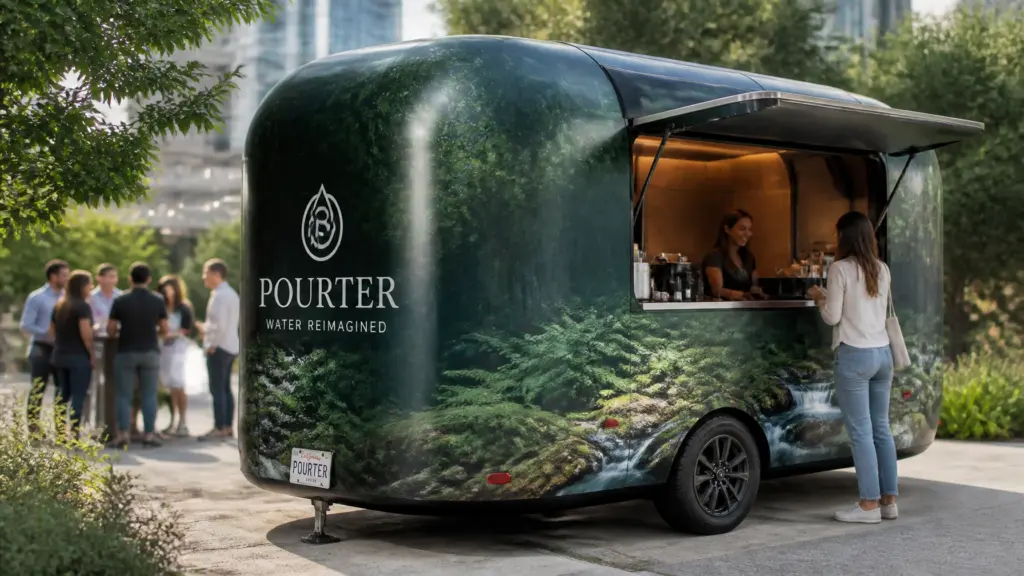
- Custom Trailer: If a $60,000 custom-built trailer: featuring the signature Pourter rounded corners and a full sleek brand wrap: nets $40,000 annually through events and strategic pop-ups, the payback period is only 1.5 years.
In a fast-growing industry where market conditions can change in a single season, the ability to reach profitability in less than two years is a decisive advantage for any business owner.

Strategic Flexibility: Taking the Product to the People
One of the most significant risks of a second brick-and-mortar location is the "fixed-address trap." If a new development project nearby stalls or foot traffic shifts to a different district, the business is anchored to a declining location by a five- or ten-year lease.
A mobile retail unit or food trailer removes this geographic risk entirely. If one location isn't performing, the asset can be moved within hours. This mobility allows brands to follow the demand, moving from corporate campuses during the week to high-traffic festivals and private events on the weekends. This "dynamic positioning" ensures that the business is always where the revenue is highest, a luxury that fixed locations simply cannot afford.
For brands like Condado Tacos, leveraging mobile units allows them to test new markets before committing to a permanent lease. It serves as a real-world feasibility study that generates profit instead of consuming it. Business owners comparing food trailers for sale near me should also consider the difference between an off-the-shelf trailer and a purpose-built expansion asset; reviewing Pourter’s portfolio and gallery makes that distinction clear.
Operations and Overhead: The Lean Growth Model
The ongoing operational costs of a physical storefront can be staggering. Rent, property taxes, high utility bills, and the maintenance of a large facility create a high "break-even" point. Every month, the business must generate a massive amount of revenue just to cover the fixed costs before a single dollar of profit is realized.
Mobile units operate on a much leaner model:
- Reduced Labor: A mobile unit can often be operated by two to three staff members, compared to the larger front-of-house and back-of-house teams required for a full restaurant.
- Lower Utilities: Powering a trailer: whether through sustainable battery solutions or efficient generators: costs a fraction of the climate control and lighting for a 2,000-square-foot building.
- Minimal Maintenance: There are no roofs to leak, no parking lots to repave, and no large dining rooms to keep clean. The focus remains entirely on the service window and the product quality.

The Billboard Effect: Brand Awareness and Design
In the Manufacturing industry, and specifically in the realm of custom food and beverage units, the visual impact of the asset is a major revenue driver. A brick-and-mortar location is a sign on a street; a Pourter custom trailer is a moving billboard.
The aesthetic of a mobile unit must reflect the quality of the brand. Pourter’s design philosophy prioritizes high-resolution, professional finishes that stand out in any environment. Every unit features rounded corners, moving away from the blocky, industrial look of traditional trailers. When combined with a full-unit sleek wrap, the trailer becomes an eye-catching brand activation tool.
Whether it is a beverage trailer for a brewery like Long Road Distillers or a retail unit for a clothing brand, the unit itself attracts customers through its superior craftsmanship and design. This visual appeal often leads to a "halo effect," driving traffic back to the original brick-and-mortar location or the brand's online store.
Mitigating Risk in an Uncertain Economy
Expanding a business is always a gamble, but the mobile model significantly de-risks the endeavor. If the economy slows or consumer habits change, a mobile asset is much easier to pivot or liquidate than a commercial lease. The resale value of a high-quality, well-maintained custom trailer remains strong, providing an exit strategy that is nearly impossible with a tenant-improved leasehold.
Furthermore, the customization process at Pourter ensures that the unit is built to the exact specifications of the workflow. This isn't a "one-size-fits-all" solution. From self-pour draft systems to complex kitchen layouts, each unit is engineered to maximize throughput and revenue per square foot.

Conclusion: Making the Strategic Move
For the established business owner looking for more revenue, the comparison between a second brick-and-mortar and a mobile unit often comes down to efficiency. While a second storefront offers a permanent anchor, the mobile trailer offers a faster ROI, lower risk, and unparalleled market reach.
By investing in a custom build that features the professional polish of rounded corners and sophisticated branding, a business can expand its footprint with confidence. The move from a single fixed location to a hybrid model: combining the stability of a home base with the agility of a mobile unit: is the most effective way to scale in the modern marketplace.
If you are ready to explore how a custom trailer can beat the traditional expansion model for your brand, visit the Pourter Gallery to see our latest builds, review our portfolio, or learn more about our design and engineering process.