
Focus keyword: food service trailers
Meta description: Learn how multi-unit and chain restaurants use food service trailers to test new markets, support catering, maintain brand consistency, and evaluate brick-and-mortar expansion.
Key Takeaways
- Mobile units give restaurant groups a lower-commitment way to test demand before signing a long-term lease.
- A repeatable trailer specification helps chains maintain consistent food quality, service, branding, and customer experience.
- Commissary planning, supplier relationships, permits, staffing, and training should be addressed before entering a new city.
- The best expansion decisions come from unit-level data, including sales, labor, food cost, throughput, repeat demand, and catering profitability.
- A successful test can become a blueprint for multiple trailers, permanent locations, or a combined mobile and brick-and-mortar network.
INTRODUCTION
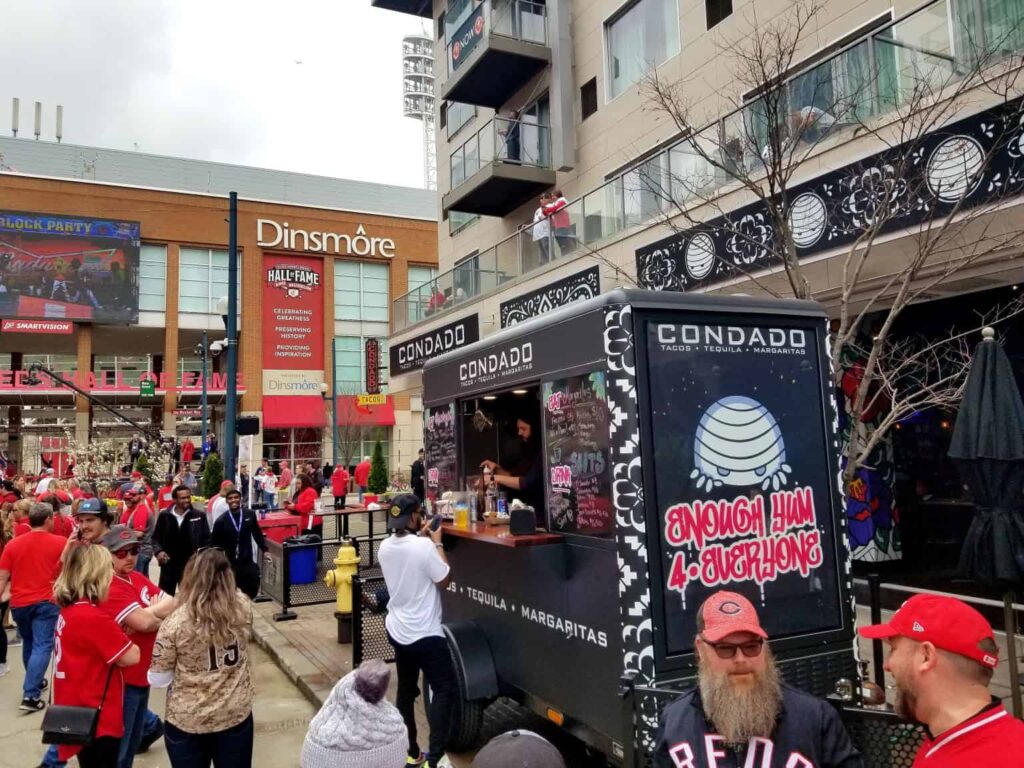
Condado Tacos, a fast-growing multi-unit taco bar chain, wanted to bring a high-volume food and beverage concept to a new audience near Cincinnati’s Reds Stadium. Instead of treating expansion as a single permanent-location decision, the brand used a purpose-built mobile unit to create a visible, flexible operating base in a high-traffic market.
That approach reflects a broader shift among restaurant groups, franchise operators, and established brick-and-mortar brands. A mobile unit can test demand, support catering, generate local awareness, and reveal operational challenges before a company commits to a full restaurant build-out.
For chains considering a new city, food service trailers can function as both revenue-producing businesses and market research platforms. The goal is not simply to open a trailer. It is to build a repeatable operating model that produces useful data and can scale into additional units.
Why should a restaurant test a market with a mobile unit first?
A permanent restaurant requires a significant commitment to real estate, construction, utilities, permitting, staffing, and fixed operating costs. A mobile unit offers more flexibility while still allowing the brand to serve customers in the target market.
Restaurant groups can use a trailer to:
- Test several neighborhoods before selecting a permanent site
- Build awareness through festivals, sports venues, and local events
- Create a catering channel for corporate and private customers
- Measure demand at different times of day and days of the week
- Evaluate local pricing and menu preferences
- Train a market-specific team before opening a larger location
This approach is especially valuable for brands with a focused menu. A coffee trailer, mobile bar, taco unit, dessert concept, or concession trailer can often deliver a recognizable experience with a smaller footprint than a full restaurant.
It also provides a practical alternative to relying only on market reports. Demographic data can identify promising areas, but live service reveals how customers actually respond to the menu, price, speed, branding, and location.
How should a chain choose a market to test?
The strongest test markets combine visible customer traffic with a clear path to recurring business. Restaurant operators should evaluate more than population size. They should look at where customers gather, how often they return, and whether the brand can operate legally and profitably in the area.
A market-selection process should include:
- Identify the target customer. Define the customer profile, spending habits, preferred meal periods, and likely use cases.
- Map high-value locations. Consider business districts, stadiums, campuses, shopping centers, breweries, parks, residential developments, and event venues.
- Review local operating requirements. Health department rules, fire inspections, vending restrictions, parking regulations, and temporary-event permits can vary by city.
- Build an event and catering pipeline. A market becomes more attractive when daily service can be combined with weddings, corporate lunches, festivals, and private events.
- Run a controlled test. Use a consistent menu, pricing structure, service schedule, and reporting process long enough to identify repeatable patterns.
An operator researching “food service trailers near me” is often looking for more than a trailer shell. They need a unit that can support a defined menu, fit a specific site strategy, and operate as part of a larger brand system.
How can a chain maintain brand consistency across multiple units?
Consistency begins before fabrication. A multi-unit operator should create a standard specification that defines the equipment package, kitchen workflow, storage, plumbing, electrical systems, exterior graphics, service window configuration, signage, and technology.
The specification should also document:
- Approved recipes and portion sizes
- Equipment operating procedures
- Opening and closing checklists
- Cleaning and food-safety standards
- Uniforms and customer-service expectations
- Menu boards and promotional materials
- POS categories and reporting requirements
- Maintenance and replacement procedures
Pourter’s Urban Trailers are designed around customizable layouts and efficient use of space, making them a practical foundation for a repeatable fleet. For brands that need a more distinctive visual presence, Classic and Vintage Trailers can carry the same operating standards with a different exterior design language.
The objective is to make every unit immediately recognizable. Full-unit graphics, coordinated colors, consistent menu presentation, and standardized staff training should make the customer experience feel connected whether the guest visits a trailer in Michigan, Ohio, Texas, or California.

What supplier and commissary logistics are needed in a new city?
A successful test depends on reliable product flow. Before launching, the restaurant group should determine what will be prepared centrally, what will be finished inside the unit, and how products will reach the new market.
A commissary or partner kitchen can support multiple units by handling bulk preparation, sauces, proteins, bakery items, beverage components, packaging, and inventory staging. This creates consistency while reducing the amount of preparation required during service.
The operator should establish:
- Approved local and national suppliers
- Delivery schedules and backup vendors
- Refrigerated and dry-storage capacity
- Water, wastewater, propane, electrical, and waste procedures
- Daily inventory transfer and receiving processes
- Allergen controls and food-safety documentation
- Contingency plans for equipment or delivery failures
This is where the difference between simply finding food trailers for sale and developing a scalable operating platform becomes clear. The trailer is one part of the system. Procurement, production, storage, transport, and service must work together.
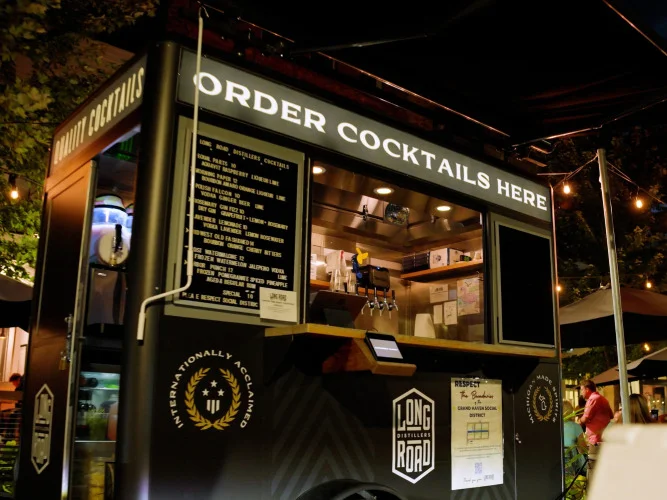
A beverage-focused operator may also need draft systems, ice capacity, glassware or packaging standards, and local alcohol compliance. Pourter’s Bar and Beverage Trailers can be configured for branded beverage programs, event service, and mobile hospitality operations.
How should the mobile team be staffed and trained?
A new-market test should not depend on one experienced employee solving every problem. The first unit needs a clear manager, documented procedures, and a training plan that can be repeated when additional units launch.
Training should cover:
- Menu preparation and portion control
- Service speed and order accuracy
- POS operation and cashless payment
- Food safety and allergen communication
- Trailer opening, closing, and cleaning
- Inventory counts and waste reporting
- Customer recovery and complaint handling
- Emergency procedures and equipment shutdown
Cross-training is particularly important in a compact unit. Employees may need to move between preparation, cooking, order taking, beverage service, and handoff during peak periods.
For a second-unit launch, an experienced lead from the first location can help train the new team. That overlap should be temporary, however. The goal is to build local management capability rather than create a permanent dependence on staff traveling between cities.
Pourter’s process includes planning, design, fabrication, delivery, and training. Learn more about the Pourter build process when evaluating how a mobile fleet can be developed as a coordinated expansion program.
Which metrics should determine whether a permanent location opens?
A trailer test should have defined success criteria before the first service day. Revenue alone is not enough. A busy location can still be unprofitable if labor, waste, event fees, transportation, or supply costs are too high.
Track performance by unit, location, event, and service period. Important measures include:
- Sales per day and per service hour
- Average ticket size
- Transactions and repeat visits
- Revenue per labor hour
- Food and packaging cost percentage
- Labor cost percentage
- Ticket time and order accuracy
- Waste, spoilage, and product availability
- Catering inquiries and conversion rate
- Profitability by event type
- Maintenance downtime
- Customer reviews and feedback
The operator should also compare weekday, weekend, lunch, dinner, event, and catering performance. A market may be strong for corporate catering but weak for daily street service. Another may support a permanent restaurant while producing limited event revenue.
The most useful test period is long enough to account for seasonality and operational learning. Instead of judging the market after one busy festival, review several months of consistent reporting and look for stable unit economics.
Which cities are good examples of location-specific testing?
In Austin, a restaurant group might test a trailer near office districts, breweries, music venues, and residential developments before selecting a permanent neighborhood. A mobile unit can move between lunch and evening demand while also serving private events.
In Chicago, the operator may need to plan around seasonal weather, event calendars, parking requirements, and indoor catering opportunities. A trailer can support summer festivals and corporate service while the brand evaluates a permanent location for year-round operations.
For customers searching “custom food trailers near me” in either city, the right question is not only which builder has available units. It is whether the unit can support the brand’s menu, local regulations, staffing model, and expansion timeline.
The same principle applies when a customer searches for a “food trailer near me” or “food truck manufacturers.” A successful multi-unit program requires design, fabrication, compliance planning, branding, and operational support: not just a finished exterior.
Pourter’s article on why Urban food trailers are transforming the mobile food business provides additional context on mobility, compact layouts, and market flexibility.
How does a successful test become multiple units?
Once the test produces reliable results, the operator should document what worked before ordering more units. Freeze the core specification, update the training materials, confirm supplier capacity, and identify the next market based on evidence rather than enthusiasm.
A practical scaling sequence is:
- Stabilize the first unit and confirm repeatable profitability.
- Document the menu, workflow, staffing, purchasing, and maintenance systems.
- Use the same core specification for Unit Two.
- Assign a manager and launch with experienced staff support.
- Review performance during the first 30 to 90 days.
- Correct operational issues before adding the next unit.
- Expand into catering, events, and additional trade areas.
- Reassess whether the market supports a permanent location.
A second or third trailer may serve a different purpose from the first. One unit may test a new neighborhood, another may focus on catering, and a third may support a flagship event calendar. The operating standards should remain consistent even when the deployment strategy changes.

What makes Pourter a useful partner for multi-unit expansion?
Pourter approaches mobile units as branded business platforms rather than generic equipment. The company’s product range includes Urban, Classic, Vintage, beverage, and custom configurations, allowing restaurant groups to align the unit with both operational needs and brand identity.
Pourter also supports the project from early planning through design, fabrication, delivery, and training. That end-to-end approach can help multi-unit operators establish a consistent specification before expanding into additional cities.
For a deeper planning framework, read How to Start a Mobile Food Business Using a Custom Trailer.
A well-designed mobile test does more than create temporary visibility. It gives a restaurant group a working model for demand, staffing, logistics, customer experience, and profitability. When the data supports expansion, the next trailer: or the next brick-and-mortar location( can be built on evidence instead of assumptions.)