
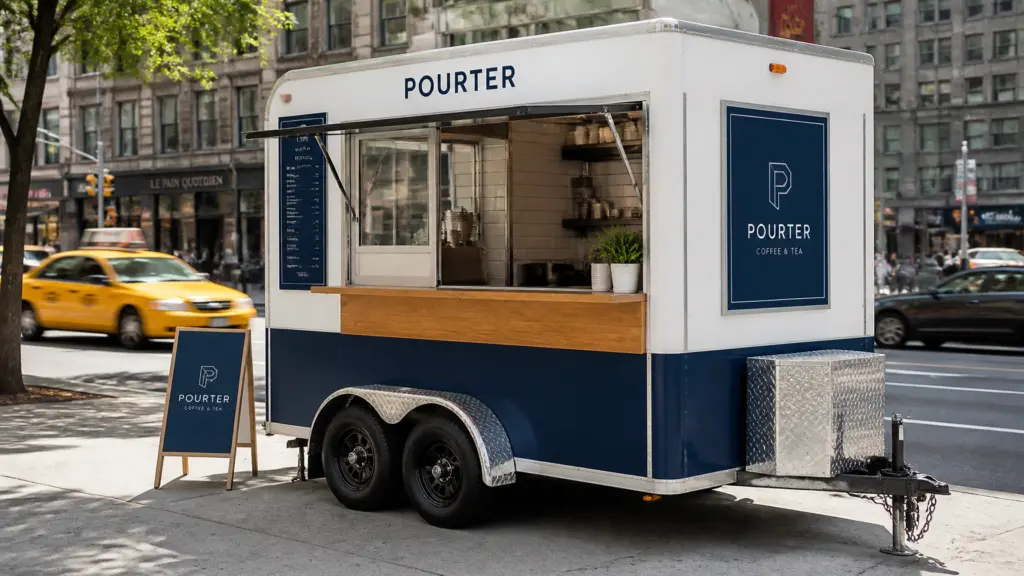
INTRODUCTION Manhattan, a global epicenter of commerce and a high-density urban environment, serves as the ultimate testing ground for the mobile food industry. For entrepreneurs and established restaurateurs alike, the allure of the Manhattan sidewalk is undeniable, offering access to millions of pedestrians, tourists, and office workers. However, the complexity of navigating New York City’s regulatory framework is a significant hurdle that requires technical precision and a strategic approach to unit design. In a landscape where every inch of curb space is contested, understanding the specific ordinances governing placement and parking is the difference between a thriving mobile enterprise and a logistical failure.
As a cornerstone of the modern street-food movement, Manhattan has implemented a intricate web of rules managed by both the Department of Health and Mental Hygiene (DOHMH) and the Department of Transportation (DOT). For those operating custom food trailers, the challenge is twofold: one must satisfy the health department's strict siting requirements while simultaneously adhering to the DOT’s stringent parking regulations.
The Regulatory Foundation: DOHMH and the "200-Foot Rule"
The primary governing body for the actual act of vending is the DOHMH. While many vendors focus on the acquisition of a mobile food vending license and a unit permit, the physical placement of the unit is where the most common compliance issues arise. Manhattan’s dense geography means that finding a legal spot often feels like a game of inches.
One of the most historic and frequently cited regulations is the "200-foot rule." Under NYC health code, mobile food vendors are prohibited from operating within 200 feet of any school. This is not merely a suggestion; it is a hard boundary enforced to manage foot traffic and student safety. Furthermore, vendors must maintain a 500-foot distance from any public market. In a borough as saturated with institutions as Manhattan, these two rules alone disqualify a significant percentage of available curb space.
Beyond these broad zones, the DOHMH mandates specific "placement" requirements that dictate exactly how a unit sits on the sidewalk or at the curb:
- Sidewalk Width: The sidewalk must be at least 12 feet wide to accommodate both the vendor and pedestrian flow.
- Curb Proximity: Units must be placed within 6 to 12 inches of the curb.
- The 10-Foot Clearance: You must stay at least 10 feet away from any crosswalk, driveway, or subway entrance.
- Building Entrances: Perhaps the most critical rule for those looking to avoid conflict with brick-and-mortar restaurants is the 20-foot rule. Vendors must be at least 20 feet from any building entrance or exit.

The DOT Distinction: Trailers vs. Trucks
A common misconception among new operators is that a food trailer is treated the same as a food truck under New York City parking laws. In reality, the NYC Department of Transportation (DOT) classifies these vehicles very differently, and the distinction is vital for anyone investing in a mobile food kiosk.
A self-propelled food truck is classified as a "commercial vehicle." Under DOT rules, these vehicles can generally park for up to three hours where parking is otherwise permitted, provided they are not in a residential zone overnight (9 p.m. to 5 a.m.) and are not occupying a metered space specifically restricted for food vending.
Conversely, a food trailer is classified as a "trailer" or "semi-trailer." According to NYC DOT traffic rules, it is illegal to park a trailer on any street or highway unless it is attached to a motor vehicle capable of towing it. Furthermore, unattached trailers are strictly prohibited on the street except in designated industrial zones with explicit signage.
For the Manhattan vendor, this means your 5×10 or 8×12 unit must remain attached to its tow vehicle at all times while on the street. This requirement significantly increases your "footprint" on the curb, making compact unit design more than just a preference: it is a survival necessity.
Footprint Matters: The Case for the 5×10 Unit
In the narrow corridors of the Financial District or the high-traffic avenues of Midtown, space is the most valuable commodity. Large, multi-axle trailers that work well in suburban environments are often non-starters in Manhattan. This is where Pourter’s expertise in compact, high-efficiency builds becomes a strategic asset.
The 5×10 unit has emerged as the gold standard for Manhattan street vending. This size allows for a complete, professional-grade kitchen or retail setup while keeping the total length of the vehicle (trailer plus tow vehicle) manageable. When you are fighting for a spot that is 20 feet away from a restaurant door and 10 feet away from a crosswalk, every foot of your unit’s length reduces your available options.

Our our process at Pourter focuses on maximizing interior volume without expanding the exterior footprint. By utilizing vertical space and high-efficiency equipment layouts, our 5×10 and 8×12 units provide the same throughput as much larger trailers, but with the agility required to navigate Manhattan's grid.
Navigating Restricted Streets and High-Traffic Zones
Even if you find a spot that satisfies all distance and parking rules, you must consult the DOHMH "Restricted Streets" list. Manhattan has dozens of blocks where vending is entirely prohibited or restricted to specific hours. These restrictions are often found in the most desirable areas, such as the areas surrounding Times Square, Herald Square, and parts of the Upper East Side near major museums.
Furthermore, many Manhattan curbs are metered. Current NYC rules generally prohibit vending from metered spaces unless you are part of a specific DOT-authorized food truck zone. These zones are highly competitive and often require additional DOT permits on top of your standard vending credentials.
Proximity to Brick-and-Mortar Establishments
While there is no specific "restaurant distance rule" beyond the 20-foot entrance requirement, successful mobile vendors understand the value of neighborhood relations. In Manhattan, the sidewalk in front of a storefront is public space, but the 20-foot door rule effectively ensures that you are not obstructing the primary path of a competitor's customers.
For entrepreneurs, the strategy should be to identify "blind spots" in the brick-and-mortar landscape: areas where demand is high but permanent storefronts are scarce. High-traffic permitted zones near office plazas or transit hubs are ideal, provided you can maintain the required clearances from subway stairs and building exits.

Conclusion: Engineering for NYC Success
Vending in Manhattan is a high-stakes endeavor that rewards those who prioritize compliance and smart design. The combination of DOHMH distance rules and DOT trailer parking restrictions creates a narrow path to success, but one that is highly profitable for those who navigate it correctly.
By opting for a compact, custom-built unit like Pourter's 5×10 or 8×12 models, you give yourself the best possible chance of finding and maintaining a legal, high-traffic location. These units are not just trailers; they are precision-engineered tools designed to thrive within the constraints of the world’s most demanding city.
Whether you are an established brand looking for a brand activation or a new entrepreneur entering the market, understanding the 200-foot rule and the "attached trailer" requirement is the first step. The second step is choosing a partner who understands that in Manhattan, smaller isn't just better( it's essential.)