
Quick Summary
- A reliable concession trailer starts with the correct chassis, axle ratings, payload capacity, and tongue-weight targets.
- A strong interior layout separates storage, prep, cooking, cleaning, and service into efficient workflow zones.
- Ventilation, fire suppression, plumbing, electrical systems, and battery capacity must be designed around the menu and local requirements.
- Heavy equipment, water tanks, batteries, and inventory should sit low and close to the axle line to support stable towing.
- Rounded-corner construction and a full brand wrap help the unit look polished, recognizable, and ready for service in any market.
INTRODUCTION
Pourter is a Michigan-based mobile food and beverage manufacturer known for turning restaurant, coffee, bar, and retail concepts into practical units built for real-world service. For entrepreneurs searching for custom concession trailers, the central question is not simply how a trailer looks. It is how every system works together once the unit is loaded, towed, inspected, staffed, and opened to customers.
A well-designed concession trailer is a complete operating environment. Its chassis must support the finished build. Its kitchen must move products from storage to service without unnecessary steps. Its water, electrical, ventilation, and fire systems must match the equipment package. Its exterior must communicate the brand clearly from the curb, event field, or parking lot.
Here is what to evaluate in a 2026 build.
What should custom concession trailers include at the chassis level?
The chassis is the foundation of the entire concession trailer. Before selecting equipment or finishes, the build team should establish the trailer’s gross vehicle weight rating, axle ratings, completed weight, and remaining payload.
The basic calculation is straightforward:
Remaining payload = GVWR − completed trailer weight
That remaining capacity must cover water, food, packaging, propane or fuel where applicable, smallwares, staff supplies, and any equipment added after delivery. A trailer that looks spacious on paper can become difficult to tow when every tank, appliance, and cabinet is full.
Tandem axles are often appropriate for larger or heavier builds because they distribute weight across more tires and provide additional load capacity. The correct choice depends on the final design, however: not simply the trailer’s interior dimensions. The axle package, tires, brakes, coupler, frame, and tow vehicle must all be considered together.
A responsible build also leaves a practical safety margin below the maximum ratings. Final numbers should be verified by the manufacturer and confirmed with a loaded weight check before regular operation.
How do weight distribution and tongue weight affect towing?
Weight distribution has a direct effect on stability. Heavy components such as refrigeration, batteries, water tanks, cooking equipment, and bulk storage should generally be placed low and near the axle line. This lowers the center of gravity and reduces unnecessary movement while the unit is being towed.
Tongue weight is the portion of the loaded trailer’s weight carried by the hitch. For many bumper-pull trailers, a common planning range is approximately 10% to 15% of the loaded trailer weight. The final target must remain within the limits of the hitch, tow vehicle, coupler, axle, and frame.
A professional manufacturer should map the expected weight of:
- Kitchen equipment
- Fresh and waste-water tanks
- Refrigeration
- Batteries and electrical equipment
- Dry goods and packaging
- Exterior cabinets or service hardware
After completion, the trailer should be weighed in its operating condition. That includes filled tanks, standard inventory, and the equipment used during service. A tongue-weight scale or certified weighing station can identify problems before they become towing problems.
Pourter’s Our Process brings design, engineering, construction, and delivery into one coordinated workflow. That approach helps connect the visual concept to the practical requirements underneath it.

How should the kitchen be organized for fast service?
The best concession trailer layouts are built around movement. A useful workflow typically follows this sequence:
Storage → prep → cooking or assembly → finishing → service
The exact arrangement changes by concept, but the major zones should remain clear.
Storage and refrigeration
Refrigeration should be close to the prep area without blocking the main aisle. Dry goods, packaging, and smallwares should have dedicated locations so employees can find them quickly during service.
Prep and assembly
Prep counters need enough working surface for the menu without forcing staff to share one cramped section. A coffee trailer may prioritize an espresso station, refrigeration, cup storage, and a dedicated pickup area. A burger or taco unit may require a different relationship between cold storage, cooking equipment, and the service window.
Cooking
Grease-producing appliances generally require a properly designed commercial hood and fire-suppression system. Cooking equipment should be positioned to support a clean handoff from preparation to finishing and service.
Cleaning
A hand sink and three-compartment sink should be placed where staff can use them without crossing the cooking line unnecessarily. Plumbing access should remain serviceable after the walls and cabinetry are installed.
Service
The window, POS station, pickup shelf, and menu display should be planned together. Customers should understand where to order and where to collect food without interrupting staff movement.
Pourter’s Urban Trailer collection is designed around compact, flexible layouts with plumbing, electrical systems, stainless counters, sinks, lighting, and storage. The model can support a food concept, coffee trailer, beverage program, or other mobile format.
What ventilation and fire-suppression systems are required?
Ventilation is both a safety system and a comfort system. A kitchen producing grease, smoke, or high heat needs a properly sized hood and exhaust arrangement. Make-up air may also be required to replace air removed by the exhaust fan and prevent excessive negative pressure inside the unit.
Fire suppression should be designed around the specific appliances. A typical grease-producing cooking line may require an automatic wet-chemical system, manual activation, fuel or electrical shutoff, and appropriate extinguishers. A Class K extinguisher is commonly associated with commercial cooking oil fires, while an ABC extinguisher may be required for other areas.
Requirements vary by state, county, city, and fire authority. Before fabrication, the equipment list and drawings should be reviewed against the jurisdiction where the unit will operate. Health departments and fire marshals may have different requirements for hood dimensions, exhaust, access panels, sinks, tank sizes, and equipment clearances.
How should water, waste, and electrical capacity be planned?
Water systems must be sized for the menu, staffing level, operating hours, and local health requirements. The build may include a fresh-water tank, waste-water tank, pump, water heater, hand sink, three-compartment sink, and dedicated drain system.
Tanks should be secured, protected from road damage, and positioned low in the trailer. Their location matters because a full tank can add substantial weight, while a partially filled tank changes the unit’s balance throughout the day.
Electrical design begins with a load list. The builder should account for refrigeration, cooking appliances, water heating, HVAC, lighting, POS equipment, signage, networking equipment, and battery charging. Peak demand and continuous demand are not always the same, so both should be considered.
Depending on the concept, a trailer may use shore power, a generator, batteries, solar charging, or a combination of systems. Battery power is especially useful for lighting, POS, displays, refrigeration support, and quiet operation between hookups. Pourter’s mobile units include technology-focused options such as lithium-ion battery systems, digital displays, and integrated POS capabilities.
A properly documented electrical panel, labeled circuits, GFCI protection near wet areas, and a safe transfer method between power sources are essential parts of a professional build.
Where does storage fit into a successful layout?
Storage is not leftover space. It is part of the operating plan.
Heavy items such as bulk ingredients, cans, cookware, and beverage containers should be stored low and close to the axle line. Light items such as cups, napkins, and paper goods can occupy overhead cabinets. Dedicated drawers and labeled bins reduce restocking time and help employees maintain inventory during a busy shift.
A good storage plan also protects the brand experience. Cleaning supplies should be separated from food and packaging. Spare parts, hoses, and maintenance items should be accessible without disrupting the customer-facing area.
Businesses comparing food trailers for sale should ask not only how much equipment fits inside but also where the operating inventory will go once the trailer is in service.
Why do rounded corners and full wraps matter?
A mobile unit has to perform as equipment and as a public-facing brand asset. Rounded exterior corners create a cleaner, more approachable profile than sharp, block-like construction. They also support the polished appearance expected from modern food, beverage, and retail concepts.
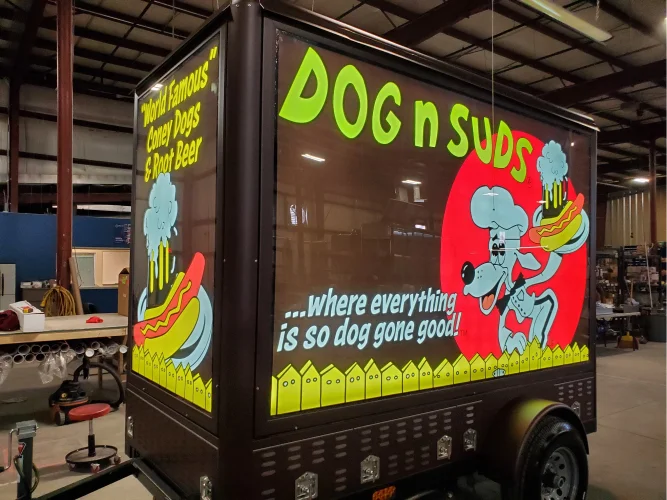
The exterior should use a complete brand wrap rather than a simple logo placed on an otherwise unfinished surface. A full wrap can carry color, pattern, menu cues, photography, typography, and a recognizable visual system across the entire unit. It helps customers identify the trailer from a distance and gives the business a consistent presence at festivals, private events, campuses, and commercial locations.
Pourter’s Classic and Vintage trailers offer a more distinctive exterior profile while retaining modern plumbing, electrical, storage, and service capabilities. For beverage-focused concepts, the Bar and Beverage Trailers collection provides another path for building a branded mobile bar or service unit.

What should operators consider in Austin, Chicago, and other cities?
Local operating conditions influence the build. An operator looking for a concession trailer near me in Austin may need to plan for intense heat, extended outdoor service, and locations with limited shade. In Chicago, towing conditions, winter storage, cold-weather plumbing protection, and indoor event access may become more important.
The same principle applies whether a business is searching for a food trailer near me in Detroit, coffee trailers near me in Grand Rapids, or custom food trailers near me in Los Angeles: local permits and operating conditions should shape the equipment package before fabrication begins.
Businesses should confirm:
- Health department requirements
- Fire-marshal approvals
- Commissary or wastewater rules
- Electrical and generator regulations
- Parking, vending, and event permits
- Seasonal weather and storage needs
A mobile food kiosk may operate in a mall, stadium, campus, brewery, or private venue rather than on a public street. The intended locations should be identified early so the trailer’s dimensions, power strategy, service window, and access points support the actual business model.
How does Pourter approach a complete build?
Pourter combines brand development, layout planning, fabrication, equipment integration, and delivery for entrepreneurs and established operators. Its portfolio includes food, beverage, bar, retail, and brand-activation units built for different service environments.
For operators evaluating custom food trucks, food truck manufacturers, or a concession trailer near me, the most important comparison is not just the starting price. It is whether the manufacturer can connect the concept, workflow, engineering, compliance, and visual identity into one usable unit.
Pourter’s guide to starting a mobile food business with a custom trailer covers concept planning, equipment, permits, branding, and launch strategy. Its article on why Urban food trailers are transforming mobile food businesses offers additional context for compact, flexible operations.
The result should be more than an attractive shell. It should be a stable trailer, an efficient kitchen, a compliant workplace, and a recognizable business that can move where customers are. That is the anatomy of a great 2026 concession trailer: and the standard that turns mobile food kiosks into durable operating platforms.