
Key Takeaways
- A 5×10 footprint provides 50 square feet of working area while staying compact enough for dense urban environments.
- The long curbside orientation supports efficient service, queue management, and clear pedestrian circulation.
- A well-planned layout can accommodate refrigeration, sinks, prep space, storage, point-of-sale equipment, and battery power.
- NYC vending rules vary by unit type, location, menu, and permit. The final design must be reviewed against current city requirements.
- Battery-powered equipment can reduce noise, eliminate tailpipe emissions, and improve the customer experience.
- Pourter builds custom mobile food and beverage units with rounded corners, full-unit wrap graphics, and layouts tailored to the operator’s menu.
INTRODUCTION New York City street vending, a cornerstone of the city’s food culture and a fast-growing opportunity for mobile entrepreneurs, demands more than a distinctive menu. Operators also need a unit that respects limited curbside space, supports a fast workflow, and can be configured for the city’s licensing and inspection requirements.
That is why the 5×10 footprint has become such an important format for NYC street vending. With 50 square feet to work with, it offers a practical balance between capacity and mobility. It is large enough to support a focused food, coffee, or beverage concept, yet compact enough to fit the operating realities of Manhattan, Brooklyn, Queens, the Bronx, and Staten Island.
Pourter’s Urban Food Trailers are available in a 5×10 configuration, giving entrepreneurs and established restaurant brands a starting point for a compact, fully customized mobile unit.
Why is 5×10 a practical size for NYC streets?
New York is a high-volume market with unusually demanding physical conditions. Sidewalks can be narrow, pedestrian traffic is constant, and fixed obstacles, including hydrants, trees, scaffolding, signposts, bike infrastructure, and building entrances, shape where a mobile unit can operate.
A 5×10 footprint reduces the amount of space a unit projects toward the sidewalk while creating a useful ten-foot service frontage along the curb. That proportion supports a straightforward operating model:
- The unit is positioned with its longer side toward the curb.
- The service window faces the pedestrian flow.
- Equipment is arranged along a compact interior work line.
- Customer queues can form beside the unit rather than across the sidewalk.
- The operator preserves space for staff movement inside the unit.
NYC’s Department of Health and Mental Hygiene states that a mobile food vending unit must have the proper permit, and the person operating it must hold the appropriate license or supervisory license. The city also publishes requirements for restricted streets, commissaries, inspections, and unit maintenance through its Mobile Food Vendors guidance.
The footprint itself is not a substitute for approval. A 5×10 unit still needs to be designed around its classification, menu, equipment, plumbing, electrical systems, and intended location. However, the format gives a manufacturer a strong foundation for a city-focused build.

How does a 5×10 layout maximize usable space?
The key advantage is not simply the number of square feet. It is how those square feet are organized.
A productive 5×10 unit should be designed around the operator’s service sequence: receiving an order, preparing or finishing the product, handing it to the customer, and restocking without unnecessary crossing or backtracking. Pourter’s design process begins with the business model, menu, equipment needs, and service goals before the final layout is developed.
A typical compact configuration may include:
- A front-facing service window: The primary customer interaction point should be easy to see and positioned for fast handoff.
- A linear prep counter: Placing refrigeration, equipment, and work surfaces in sequence reduces staff movement.
- Dedicated handwashing and warewashing areas: Sink placement should support sanitation and meet the requirements associated with the unit’s menu and inspection category.
- Under-counter storage: Dry goods, packaging, cleaning supplies, and smallwares can be stored below work surfaces.
- Vertical storage: Shelving and overhead compartments increase capacity without expanding the footprint.
- Integrated battery and electrical systems: Power equipment can be built into a protected service area rather than taking up valuable prep space.
- Compact point-of-sale technology: Digital POS systems and menu displays reduce counter clutter and help speed up transactions.
This approach is useful for a coffee trailer, a focused lunch concept, a concession trailer, or a mobile bar serving a limited beverage menu. It is less about fitting every possible appliance into a small unit and more about choosing the equipment that supports the highest-volume products.
Is a 5×10 unit large enough for a coffee or food business?
For a focused concept, yes. A 5×10 unit can be highly effective when the menu is designed around a clear production system.
A coffee trailer might prioritize an espresso machine, grinder, under-counter refrigerator, ice storage, water and wastewater systems, syrup organization, cup storage, and a pastry display. A food trailer might use a compact griddle, induction equipment, fryer, refrigeration, warming equipment, prep tables, and ingredient storage. A mobile bar may need refrigeration, ice management, draft or self-pour equipment, a hand sink, speed rails, and bottle storage.
The most successful compact units do not try to replicate a full restaurant kitchen. Instead, they extend an existing business with a controlled menu and a faster service model. This makes the format especially useful for:
- Brick-and-mortar restaurants testing a new neighborhood
- Multi-unit restaurant groups expanding into events
- Coffee shops serving office districts or campuses
- Entrepreneurs launching a focused specialty concept
- Beverage brands conducting retail activations
- Bars adding a mobile service channel
- Catering companies seeking new event capacity
Operators comparing food trailers for sale should look beyond the advertised dimensions. The important questions are whether the unit can support the intended menu, whether the plumbing and electrical systems are correctly integrated, and whether the manufacturer will help align the build with applicable local standards.
Why does battery power matter in a compact NYC unit?
Battery power is particularly relevant when every interior inch and every neighborhood interaction matters.
Traditional generators can occupy space, require fuel, create vibration, and introduce noise into an already active streetscape. A properly engineered lithium-ion battery system can power lighting, refrigeration, POS equipment, and selected cooking or beverage equipment without the sound and exhaust associated with a gas generator.
Pourter describes its compact trailers as quiet, lightweight, and battery-powered, with systems designed to support mobile operations. The practical benefits include:
- Quieter communication between customers and staff
- No visible generator exhaust at the service window
- Less interruption for nearby residents and businesses
- Reduced fuel handling during the workday
- Cleaner presentation for premium brands and retail activations
- Greater flexibility for private events and indoor-adjacent applications
Battery capacity still has to match the load. Espresso machines, induction cooking, refrigeration, ventilation, and heating equipment can draw significant power. A responsible build therefore starts with an equipment schedule and an energy-use calculation rather than treating the battery as an afterthought.
For a deeper look at the transition, read Pourter’s guide to sustainable power and the future of street vending.

What does compliance mean for a 5×10 NYC street-vending project?
Compliance begins with the business concept, not after fabrication is complete.
NYC operators should confirm the correct license and permit path, proposed operating location, commissary or approved servicing arrangement, menu classification, plumbing requirements, electrical design, fire and ventilation needs, and inspection process. The city’s official guidance explains that permitted units must be cleaned, serviced, and stored at an approved facility, with the unit returned for regular maintenance.
The city has also announced an expansion of mobile food vending opportunities. Beginning July 1, 2026, at least 2,200 new supervisory license applications are expected to be offered each year for five years, contributing to an overall increase of 11,000 available permits. More opportunities will also mean more competition for visible, workable locations.
Pourter’s NYC-certified mobile food cart buyer’s guide covers the importance of aligning the unit’s size, plumbing, surfaces, and equipment with current requirements. Because rules can change, operators should confirm details directly with NYC agencies before approving a final build.
How can a 5×10 unit look distinctive without becoming visually bulky?
Compact does not have to mean generic.
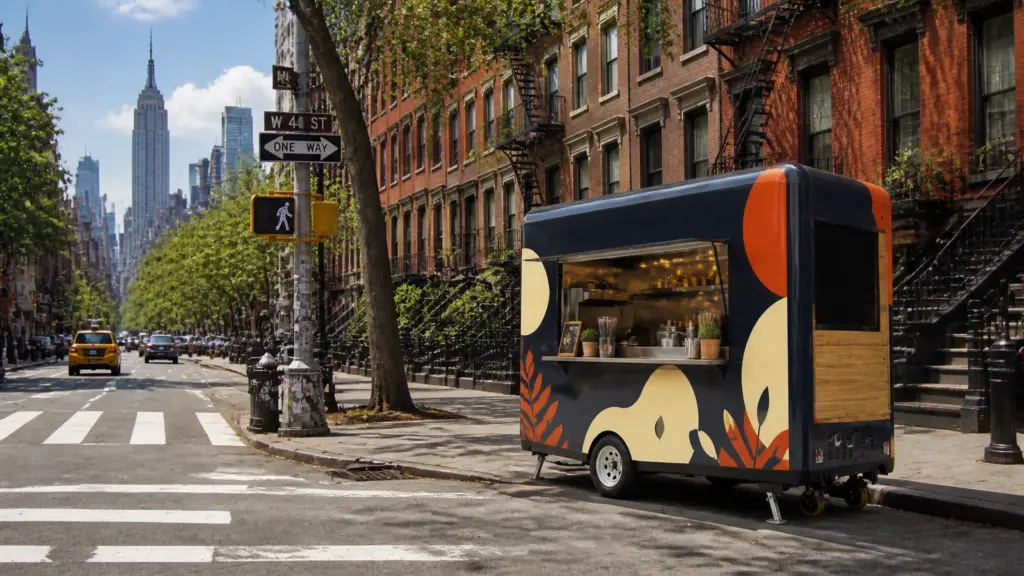
A unit on a New York street competes with storefronts, signage, traffic, construction barriers, and thousands of other visual signals. A full-unit wrap helps turn the entire exterior into a controlled brand surface. Instead of applying a small logo to a plain trailer, operators can use color, pattern, photography, illustration, and menu cues across the rounded body.
That treatment is valuable for both direct sales and brand activation. A coffee trailer near me should be easy to recognize from a distance. The same is true for a food trailer near me or a mobile bar at a private event. The unit should communicate what it sells before the customer reaches the service window.
For brands seeking a more elevated finish, Pourter’s Classic and Vintage trailers add a polished visual identity, while the Next-Gen collection is designed for premium materials, advanced features, and high-impact branding. Each format can be adapted around the operator’s service model, subject to the required dimensions and local approvals.

Does the 5×10 format work outside Manhattan?
Yes. The same compact logic applies across the five boroughs, but the operating strategy may change by neighborhood and permit type.
In Manhattan, a 5×10 unit can support a tightly controlled curbside service model near offices, high-traffic retail areas, and approved event locations. In Brooklyn, the format can work well for coffee, bakery, and specialty food concepts serving neighborhood corridors. Queens offers opportunities around cultural events, commercial districts, parks, and private properties, subject to the applicable permit and site rules.
If you are searching for custom food trailers near me in New York City, the right manufacturer should ask where you plan to operate, what you plan to serve, and how the unit will be serviced: not simply what color you want on the exterior. The same questions matter when comparing food truck manufacturers or looking for a custom food trailer near me in another city such as Austin, Chicago, or Los Angeles.
What should NYC operators do next?
Start with the menu, the service volume, and the intended operating environment. Then translate those requirements into a 5×10 layout that gives every inch a job.
Pourter’s custom design process includes planning, design, fabrication, delivery, and training. That process helps operators move from a broad idea: such as a coffee trailer, concession trailer, or mobile bar: to a practical unit with the equipment, branding, storage, and power system needed for daily service.
A 5×10 footprint will not solve every permitting or location challenge in New York City. It does, however, give street vendors a compact, efficient, and highly adaptable platform. With rounded corners, a sleek full-unit wrap, a battery-optimized electrical plan, and a layout built around the menu, it can become a durable extension of a restaurant, a launch platform for an entrepreneur, or a visible new channel for an established brand.
For operators ready to explore a compliant, branded mobile unit, contact Pourter to begin the conversation.