
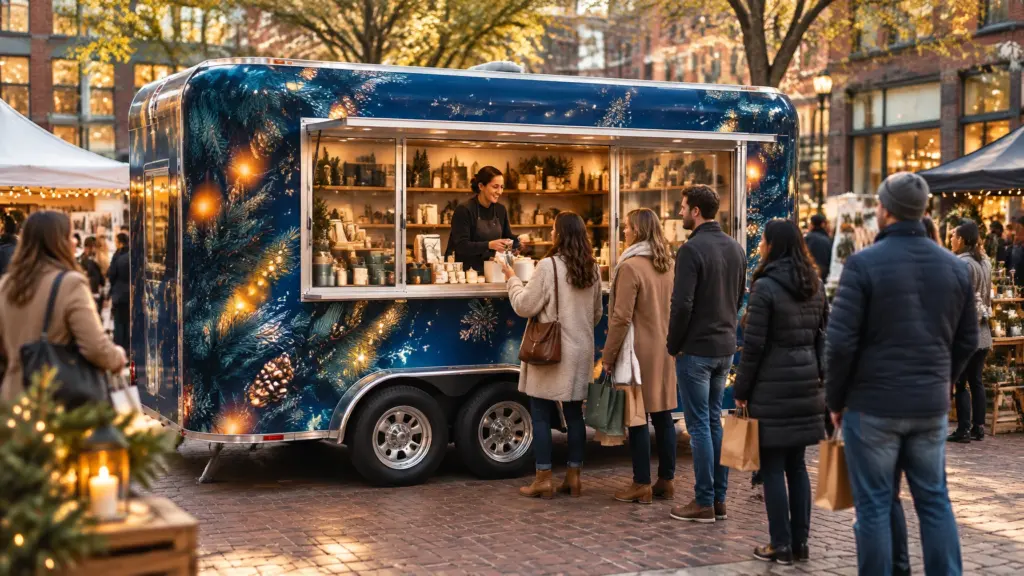
Meta description: Learn how mobile pop up shops help retailers capture Q4 revenue through strategic site selection, compact merchandising, battery power, event circuits, and measurable ROI.
Key Takeaways
- Custom mobile retail units let brick-and-mortar retailers reach seasonal demand without committing to a long-term storefront lease.
- Strong Q4 planning depends on site selection, event and market circuits, curated merchandising, staffing, and reliable power.
- Battery-powered systems can support quiet indoor activations where generators, fumes, and excessive noise are not permitted.
- A mobile unit should be measured against a short-term lease using revenue per stop, contribution margin, customer data, and brand engagement.
- Pourter builds rounded-corner, fully branded mobile units designed to function as both retail environments and high-impact marketing assets.
INTRODUCTION
Pourter, a Michigan-based manufacturer of custom mobile food, beverage, and retail units, is part of a fast-growing shift in how established brands reach customers during the holiday selling season. For brick-and-mortar retailers, Q4 remains a cornerstone revenue period, but a permanent second location is not always the right answer. A custom trailer can bring a curated store, seasonal collection, or brand experience directly to high-traffic destinations.
The result is a flexible retail footprint that can move between holiday markets, shopping districts, corporate campuses, sporting events, and indoor venues. Instead of waiting for customers to visit one address, retailers can build a schedule around where demand already exists.
How do mobile pop up shops support Q4 revenue?
Q4 creates concentrated demand, but it also creates concentrated operating risk. Permanent retail expansion requires construction, staffing, utilities, insurance, and a lease that may extend well beyond the holiday season. A mobile retail unit allows a business to test several markets over the same period while maintaining a consistent customer experience.
A retailer might use one trailer for:
- Holiday gift collections and limited-edition launches
- Seasonal apparel or accessories
- Product sampling and demonstrations
- E-commerce returns, pickup, and customer acquisition
- Corporate gifting programs
- Brand partnerships at festivals and sporting events
- Temporary coverage while a permanent location is renovated
The trailer becomes more than a sales counter. With the right layout and full-unit graphics, it operates as a compact storefront, moving billboard, and customer-experience platform.
The model also shares design principles with a food trailer, coffee trailer, mobile bar, or concession trailer. Each requires a clear service path, durable materials, efficient storage, and a professional exterior that communicates value before the customer steps inside. That is why retailers often consult experienced food truck manufacturers and custom food truck builders when evaluating mobile infrastructure, even when the end use is non-food retail.
What should retailers consider when selecting Q4 sites?
Site selection should begin with customer behavior rather than available parking. The best location is not always the busiest location; it is the place where the right audience has time and motivation to engage.
Retailers should evaluate:
- Audience fit: Does the area attract the customers most likely to purchase the product?
- Dwell time: Will people have enough time to browse, try, compare, or ask questions?
- Visibility: Can the unit be seen from the primary pedestrian or vehicle approach?
- Access: Are loading, parking, power, restrooms, and inventory replenishment practical?
- Permission: Does the property owner or event organizer allow temporary retail sales?
- Seasonal traffic: Does the location have a reliable holiday market, festival, or shopping pattern?
Platforms such as Peerspace and Storefront can help teams research short-term commercial spaces. Retailers should also speak directly with shopping districts, event organizers, hotels, campuses, breweries, and property managers.
Search behavior can be useful, too. A consumer searching for a mobile pop up shop near me may be looking for an event, seasonal collection, or nearby brand experience. A retailer can capture that intent through updated local listings, event pages, social posts, and a clear schedule showing where the unit will be next.
How can one trailer support an event and market circuit?
A Q4 trailer performs best when treated as a circuit rather than a single-location store. A practical schedule may include weekday stops at corporate campuses or downtown districts, followed by weekend appearances at holiday markets, sports venues, and shopping centers.
The circuit should be planned around:
- Travel time and towing logistics
- Inventory volume and replenishment needs
- Local permits and event rules
- Setup and breakdown requirements
- Staffing availability
- Expected revenue per stop
- Weather and indoor backup options
Retailers should create an operating calendar early, then rank stops by expected contribution margin. A prestigious event may create valuable exposure but produce less direct revenue than a smaller market with strong product fit. Both can be worthwhile, but they should be measured differently.
Pourter’s custom design and build process is structured around planning, design, construction, delivery, and training. That end-to-end approach is useful for retailers that need the unit to support a repeatable multi-city schedule rather than a one-time activation.
How should brands merchandise a small footprint?
A mobile store cannot carry a full department-store assortment. Its advantage is curation. Q4 merchandising should focus on products that are easy to understand, easy to carry, and connected to a clear seasonal message.
Effective strategies include:
- Feature a small number of hero products near the service or entry area.
- Use vertical shelving and wall-mounted displays to preserve floor space.
- Place gift sets and higher-margin products at natural stopping points.
- Keep checkout, pickup, and browsing paths distinct.
- Use concealed storage for replenishment inventory.
- Add QR codes for extended sizes, colors, online ordering, and shipping.
- Create a dedicated area for personalization, demonstrations, or sampling.

A full-unit wrap extends the merchandising strategy beyond the interior. Pourter’s units are designed with rounded corners and complete branded graphics rather than a basic logo application. The exterior should communicate the campaign from a distance, while the interior should make the purchase process simple and comfortable.
Retailers considering a premium presentation can explore Pourter’s Next-Gen trailer collection. For a more compact launch, the Urban trailer collection offers a smaller footprint with customizable layouts, lighting, service windows, storage, plumbing, and electrical systems. Brands seeking a distinctive vintage appearance can review the Classic and Vintage collection.
How many employees does a mobile retail unit need?
Staffing should be based on customer volume, transaction complexity, and the experience the brand wants to create. A small activation may operate with two cross-trained employees: one focused on customer engagement and one handling transactions, inventory, and operational checks.
Higher-volume events may require:
- A greeter or queue manager
- Product specialists
- A dedicated checkout or pickup employee
- An inventory and replenishment lead
- A field manager responsible for opening, closing, and compliance
Training should cover more than product knowledge. Staff need a concise setup and breakdown procedure, payment-system protocols, inventory counts, emergency procedures, and a clear method for capturing customer information with permission.
The goal is to keep the unit open and customer-ready. Every minute spent searching for stock, managing clutter, or troubleshooting equipment reduces the value of the site.
Can battery power support indoor holiday activations?
Battery power can significantly expand where a mobile retail unit operates. Convention centers, hotels, malls, museums, stadiums, and corporate buildings may restrict generators, fuel, exhaust, or excessive noise. A properly specified lithium-ion system can support lighting, point-of-sale equipment, displays, networking hardware, and other planned loads without the sound and fumes associated with a traditional generator.

Pourter describes its compact Urban trailers as lightweight, quiet, and battery-powered, with electrical planning integrated into the build. Retailers should still develop a load schedule with their builder and venue. Lighting, climate control, refrigeration, digital displays, and charging requirements all affect runtime.
Indoor deployment also requires early attention to:
- Door and loading-dock dimensions
- Floor protection and weight limits
- Fire and electrical requirements
- Venue-approved power connections
- Internet and point-of-sale connectivity
- Emergency access and customer flow
Pourter’s guide to integrating battery-powered units into indoor events explains why silent, fume-free operation is increasingly important for premium activations.
How should retailers measure ROI against a short-term lease?
The right comparison is not simply trailer cost versus monthly rent. Retailers should compare the total cost of reaching customers through each channel.
For a mobile activation, track:
- Build or rental cost
- Transportation and storage
- Site fees, permits, and insurance
- Staffing and travel
- Inventory and replenishment
- Marketing and event sponsorship
- Power, connectivity, and maintenance
- Revenue and contribution margin per stop
Then compare those expenses with:
- Units sold
- Average order value
- Gross margin
- Revenue per operating hour
- Email or SMS signups
- New customer acquisition
- Repeat purchases after the event
- Social content and press exposure
- Wholesale, partnership, or location leads
A short-term lease may provide a stable address but limit the brand to one market. A trailer may require more planning and transportation, yet it can serve multiple locations and remain useful after the Q4 campaign. The best decision depends on the retailer’s goals, product economics, and growth plan.
Pourter’s article on mobile retail unit ideas offers additional examples of how a custom unit can support product launches, sampling, hospitality, and experiential marketing.
Where can retailers deploy mobile retail units in the United States?
New York City
In New York City, retailers can consider holiday markets, private courtyards, corporate campuses, and organized events where temporary retail is permitted. Space constraints make compact design especially important. A unit should arrive with a detailed logistics plan covering loading, parking, power, staffing, and inventory.
Retailers should also confirm requirements with the property owner and relevant city agencies before committing to a schedule. A well-designed unit can provide a flexible presence in neighborhoods where a traditional storefront would be expensive or difficult to secure.
Chicago
Chicago offers a strong Q4 mix of downtown retail, neighborhood markets, sports venues, convention activity, and corporate events. Winter conditions make insulation, heating, weather planning, and reliable transportation essential. Indoor activations can provide a valuable complement to outdoor holiday markets.

For brands searching mobile retail units near me, the practical question is not only who builds the unit, but who can support the layout, power, branding, and operational requirements of the intended market. Retailers in Chicago should also review local event rules and fire-safety requirements before finalizing a circuit.
Austin, San Diego, Atlanta, Dallas, and other fast-growing markets can offer similar opportunities, although permits, site access, and seasonal traffic patterns vary by city. The same research applies to businesses comparing a food trailer near me, a branded coffee trailer, or a full retail activation: local approval and site-specific logistics should be addressed before construction.
Why work with Pourter on a Q4 retail unit?
A successful mobile retail program requires more than an attractive exterior. It needs a durable shell, efficient interior flow, reliable systems, integrated branding, and a build process that accounts for the campaign’s operating schedule.
Pourter approaches each project as a custom mobile environment. Rounded-corner construction, full-unit wrap graphics, modular layouts, battery-power options, and integrated technology help retailers create a unit that feels intentional and professional at every stop.
For additional planning guidance, read “Looking for Mobile Pop-Up Shops? Here Are 10 Things You Should Know Before You Build”. Whether the goal is a holiday boutique, product launch, sampling program, or multi-city brand tour, the right custom trailer can turn Q4 demand into a measurable, repeatable growth channel.