
Key Takeaways
- Battery-powered vending units can provide quiet, low-emission service without an on-site gasoline generator.
- A 5×10 custom food trailer can be designed around energy demand, equipment loads, storage, and NYC operating conditions.
- NYC does not currently appear to offer a dedicated city grant specifically for battery-powered street vending carts. Broader NYSERDA, property, charging, and small-business programs may still be relevant.
- Battery power does not replace permits or inspections. Vendors must still address health, electrical, fire, sanitation, accessibility, and operating requirements.
- Pourter builds custom food trailers, coffee trailers, mobile bars, and concession trailers with battery, solar, and electric power options.
INTRODUCTION
New York City street vending is a historic and fast-moving part of the city’s small-business economy. From coffee carts outside subway stations to food trailers serving lunch in busy commercial districts, mobile vendors operate where foot traffic is concentrated and customer demand changes by the hour.
The next phase of that market is increasingly focused on clean energy.
A battery-powered cart or compact 5×10 food trailer can support zero-emission service at the point of sale while reducing generator noise, local exhaust, and dependence on fossil fuels. For NYC vendors, restaurants, and entrepreneurs, the opportunity is not simply to replace a generator. It is to build a more efficient mobile operation that aligns with the city’s broader climate, electrification, and sustainability goals.
Why does battery power matter for NYC street vending?
Traditional generators can create noise, exhaust, fuel-storage concerns, and maintenance demands in dense urban environments. Those issues become more noticeable on narrow sidewalks, at outdoor markets, and near residential buildings.
A properly engineered battery system changes the operating profile of a mobile unit. It can power refrigeration, lighting, point-of-sale technology, small appliances, pumps, and other electrical loads without producing tailpipe emissions while the unit is serving customers.
Battery power also supports a cleaner customer experience:
- Quieter service windows
- No visible generator exhaust
- Fewer fuel-handling tasks
- More flexible placement at events and markets
- Consistent power for lighting, refrigeration, and digital payment systems
- Potentially lower maintenance compared with combustion equipment
The system still has to be sized correctly. A coffee trailer with an espresso machine, grinder, refrigeration, and water-heating equipment will have a very different energy profile from a cart serving pre-prepared food or a mobile bar focused on refrigeration and dispensing.
Pourter’s earlier guide, Why Lithium Battery Power Will Change the Way You Run Your Food Trailer, explains why energy storage is becoming a central design decision for mobile food and beverage businesses.

What does zero-emission vending actually mean?
In practical terms, zero-emission vending means the mobile unit produces no on-site tailpipe emissions while operating. A battery-powered food trailer does not burn gasoline or diesel at the service location, which can improve air quality around employees, customers, pedestrians, and nearby businesses.
That does not mean the unit has no environmental impact. The battery must be manufactured, charged, maintained, and eventually recycled. The overall sustainability benefit depends on the electricity source, charging schedule, battery lifespan, equipment efficiency, and operating practices.
For that reason, vendors should evaluate the complete energy plan:
- List every electrical load.
- Estimate peak and average daily consumption.
- Determine charging time and location.
- Select appropriate battery capacity and protection systems.
- Add energy-efficient refrigeration, lighting, and appliances.
- Create a backup plan for extended service periods or delayed charging.
The goal is not to claim that every battery-powered unit is automatically sustainable. The goal is to design a system that measurably reduces fossil-fuel use and operates efficiently in the real world.
How can a 5×10 food trailer be optimized for NYC?
A 5×10 footprint is compact enough for urban mobility but large enough to support a focused menu, coffee service, beverage dispensing, or specialty food concept. The design challenge is using every inch without creating unsafe congestion.
A strong NYC-ready layout typically considers:
Energy loads
High-draw equipment should be identified before fabrication begins. Espresso machines, induction cooking equipment, hot-holding units, refrigeration, water heaters, and ventilation systems can determine the battery size and electrical architecture.
Workflow
The most efficient layouts move in a logical sequence: storage, preparation, cooking or finishing, and service. Urban food trailer layout planning shows how linear and parallel configurations can reduce staff movement and improve service speed.
Weight distribution
Batteries, refrigeration, water tanks, cooking equipment, and storage all affect the unit’s total weight and balance. A custom build should account for placement, towing, mobility, and the intended operating environment.
Service windows
The service window is the point where the brand meets the street. It should support fast ordering, payment, pickup, and customer flow without obstructing sidewalks or creating unnecessary cross-traffic.
Branding
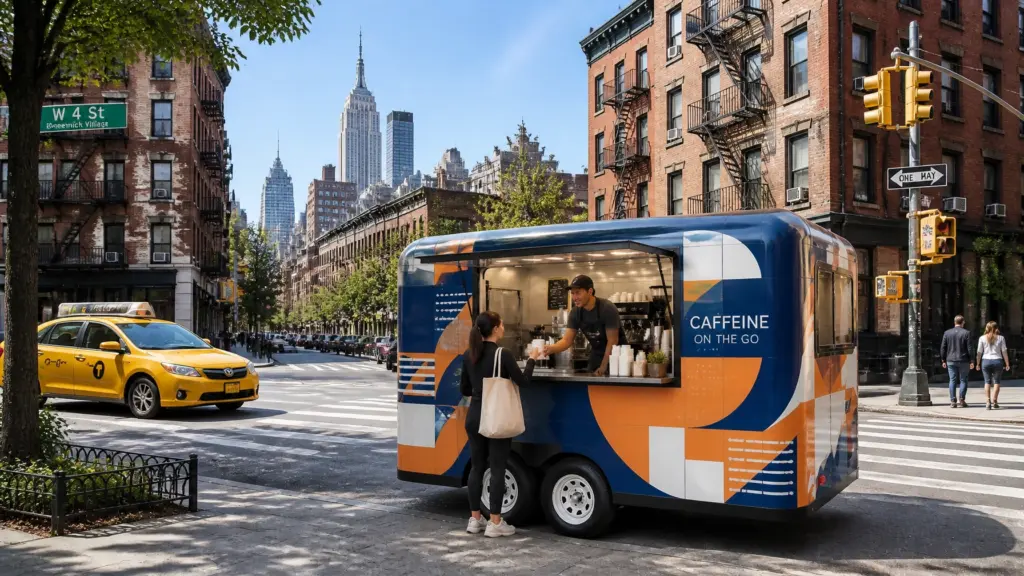
In a dense market, the trailer must be visible from a distance. A complete full-unit wrap creates a stronger presence than a simple logo applied to a blank exterior. Deep blues, warm oranges, and clean white graphics can provide a modern visual identity while helping a mobile brand stand apart in a crowded NYC streetscape.
Pourter’s urban trailer collection is designed for businesses that need compact, efficient, highly visible mobile units.
What incentives or grants are available for battery-powered vending in NYC?
As of August 2026, NYC does not appear to have a dedicated citywide grant designed specifically to subsidize battery-powered street vending carts. That distinction matters. Vendors should not assume that an electric cart automatically qualifies for a clean-energy rebate.
However, several broader programs may be relevant depending on how the business is structured.
NYSERDA transportation and charging programs
New York State’s NYSERDA transportation programs include clean transportation initiatives, commercial transportation programs, and electric charging station support.
The page identifies a potential income tax credit of up to $5,000 per charging station and a Charge Ready NY rebate of up to $4,000 per Level 2 charging station. These programs are generally directed toward eligible vehicles and charging infrastructure, not directly toward vending carts.
A vendor may still find a path to support if the operation includes:
- A qualifying electric tow vehicle
- A fixed commissary or charging location
- Level 2 charging equipment
- A property-based energy-storage installation
- A broader commercial electrification project
Eligibility, deadlines, technical requirements, and funding availability should be confirmed before a business includes an incentive in its project budget.
NYC clean-energy property benefits
The NYC Clean Energy Systems Exemption can provide a property-tax benefit for eligible solar, wind, energy-generation, and energy-storage systems. The exemption applies to qualifying increases in assessed value for up to 15 years.
This is a property-level benefit, not a direct rebate for a mobile food trailer. It may be more relevant to a commissary, market operator, restaurant group, or property owner installing a charging and energy-storage system that supports several mobile units.
City of Yes and charging infrastructure
NYC’s City of Yes for Carbon Neutrality initiative addresses zoning and building-related barriers to clean-energy infrastructure, including EV charging. It does not create a special permit for battery-powered street vending, but it may make fixed charging locations easier to plan over time.
The city has also pursued major investment in curbside EV charging. Those efforts support transportation electrification, but they should not be confused with a dedicated vending-cart charging program.
What permits and compliance issues should vendors consider?
Battery power does not eliminate the need for standard street-vending compliance. A business should use NYC’s official Business Regulations Index and Step-by-Step tool to identify current permits, licenses, and operating requirements.
The exact requirements will depend on the menu, equipment, location, and operating model. A vendor may need to address:
- Food-vending licenses and permits
- Health and sanitation requirements
- Electrical-system safety
- Fire-safety provisions
- Safe battery enclosure and ventilation
- Water and wastewater handling
- Refrigeration and food-temperature control
- Equipment clearances
- Towing, parking, and site access
- Signage and customer-flow considerations
A compliant build begins with these requirements, not after fabrication. Pourter works with clients to plan the equipment package, electrical architecture, layout, finishes, and branding as one integrated project.

Is a battery-powered coffee trailer or mobile bar practical?
Yes, provided the energy plan matches the concept.
A coffee trailer may require substantial power for espresso equipment, grinders, refrigeration, water heating, and lighting. A mobile bar may use power for refrigeration, draft systems, ice equipment, pumps, lighting, and point-of-sale technology. Both can be designed around battery power, but neither should be treated as a one-size-fits-all build.
Pourter’s mobile bar trailer solutions demonstrate how a compact unit can combine service efficiency, refrigeration, dispensing, and high-impact branding. The same planning principles apply to coffee trailers, beverage carts, and specialty concession trailers.
For businesses comparing food trailers for sale, the key question is not simply whether the unit looks attractive. Buyers should ask:
- What power system is included?
- What equipment can run simultaneously?
- How long can the unit operate between charges?
- Where will charging occur?
- Is the layout designed for the actual menu?
- Can the system be expanded or serviced?
- Does the unit support the required inspections?
Where can NYC vendors start?
Whether you are searching for a food trailer near me, custom food trailers near me, or food truck manufacturers near me, the most important step is to define the operating model before requesting a quote.
In NYC, that may mean a coffee trailer in Manhattan, a compact food unit in Brooklyn, or a branded mobile bar supporting events in Queens. The same process can help operators in other major markets, including Los Angeles and Detroit, where local permits and infrastructure will differ but energy planning remains essential.
Pourter’s trailer collection includes custom-built mobile food and beverage units for restaurants, entrepreneurs, retailers, bars, and brand activations. A 5×10 battery-powered unit can give an established business a flexible way to test neighborhoods, support events, expand catering, or build a second revenue channel without opening another permanent location.

What is the outlook for zero-emission street vending?
NYC’s clean-energy transition is broader than any single cart or trailer. The city is working across transportation, buildings, charging infrastructure, and energy storage. Street vendors will be affected by that transition even when a program does not specifically mention vending equipment.
For operators, the practical objective is clear: build mobile units that use less fossil fuel, produce no on-site exhaust, reduce unnecessary noise, and remain efficient under demanding urban conditions.
That starts with a correctly engineered battery system, a compliant layout, durable construction, and a brand presentation built for the street. For entrepreneurs researching custom food trucks, food trailers for sale, or a concession trailer near me, clean energy should be part of the first design conversation( not an afterthought added at the end.)