
Key Takeaways
- A battery-powered unit still requires the same core NYC food-vending licenses, permits, inspections, and operating approvals as other mobile units.
- The 5×10 footprint should be treated as a critical design target for an NYC sidewalk vending concept, but the final unit must be reviewed against current city requirements.
- Your menu determines equipment, plumbing, refrigeration, ventilation, power demand, and inspection requirements.
- A practical launch plan includes licensing, commissary service, location research, unit design, battery planning, and daily operating procedures.
- Pourter builds custom food trailers, coffee trailers, mobile bars, and other branded units around the operator’s menu and service model.
INTRODUCTION
New York City’s Street Vendor Project (SVP), a cornerstone legal and advocacy resource for the city’s long-standing vendor community, is helping bring greater attention to the future of street vending. At the same time, NYC is expanding mobile food vending opportunities and exploring cleaner alternatives to gasoline and diesel generators.
For entrepreneurs, restaurants, coffee shops, and established food businesses, this creates a timely opportunity. A well-planned battery-powered unit can provide a quieter, cleaner operating platform without sacrificing the visual impact of a professional food business. But the opportunity requires more than purchasing a trailer and finding a busy corner. Licensing, inspection, location restrictions, food sourcing, power capacity, and daily storage all need to work together.
This guide explains how to approach an NYC street vendor project from the first concept through daily operation.
What Is the NYC Street Vendor Project?
The Street Vendor Project is a program of the Urban Justice Center that supports street vendors through advocacy, education, research, and legal resources. Its work reflects the importance of vending to New York’s neighborhoods and small-business economy.
For a new operator, SVP can be a useful resource alongside official NYC agencies. The city’s mobile food vendor information should remain the primary source for current licensing and permit requirements, while the Street Vendor Project resource center provides broader context and vendor-focused guidance.
In 2026, NYC is beginning to expand access to mobile food vending permits. The Health Department states that 2,200 new supervisory license applications will be offered each year for five years, creating 11,000 additional opportunities overall. Eligibility, waitlists, and permit categories still matter, so operators should confirm their situation before committing to a build.
What License and Permit Does a Battery-Powered Vendor Need?
Battery power does not create a separate license category. NYC requirements are based primarily on what you sell, where you operate, and how your unit is permitted.
For a food business, the launch plan generally includes:
- Mobile Food Vendor License: The individual working on the cart or trailer must hold the appropriate NYC mobile food vendor license and complete the required food protection training.
- Mobile Food Vending Unit Permit: The unit itself must be permitted by the NYC Department of Health and Mental Hygiene.
- Supervisory license or applicable permit pathway: Full-term permits can be subject to waitlists and supervisory-license requirements.
- Food sourcing and commissary documentation: Food must come from an approved source, and the unit must be cleaned, serviced, and stored through an approved commissary, depot, or alternative facility where permitted.
- Event permits: Street fairs, festivals, and other temporary events may require a Temporary Food Establishment permit in addition to regular approvals.
Review the city’s full-term mobile food vending permit requirements before finalizing your equipment package. The unit must pass inspection within the applicable timeline, and the permit process should be considered during design: not after fabrication.
Why Should the Unit Be Designed Around a 5×10 Footprint?
A 5×10 unit provides approximately 50 square feet for food preparation, storage, refrigeration, handwashing, service, and electrical systems. In a dense city, that footprint must be used carefully.
Before choosing equipment, map the complete workflow:
- Receiving and storing ingredients
- Refrigerated and hot holding
- Food preparation
- Handwashing and utensil washing
- Order assembly
- Customer service
- Waste handling
- Battery access and monitoring
A 5×10 concept is especially relevant for coffee, packaged food, light preparation, and compact concession operations. High-volume cooking may require more substantial ventilation, grease management, plumbing, and electrical planning. The final dimensions and equipment must be reviewed against current NYC requirements and the specific operating location.
Pourter’s Urban Food Trailers are available in 5×10 and 6×10 configurations, with plumbing, electrical systems, stainless countertops, sinks, service windows, lighting, and storage. The right layout depends on your menu and the approvals required for your unit.

How Do You Choose the Right Battery System?
Power planning should start with the menu. A coffee trailer with an espresso machine, grinders, refrigeration, water pumps, lighting, POS equipment, and HVAC has a different load profile from a grill-heavy concession trailer.
Create a power schedule that accounts for:
- Appliance wattage
- Startup and surge loads
- Hours of operation
- Refrigeration cycling
- Lighting and point-of-sale equipment
- Battery charging time
- Backup requirements
- Seasonal temperature conditions
Battery systems can be a strong fit for coffee, beverages, refrigeration, lighting, POS, and other moderate-load operations. They eliminate on-site fuel storage and reduce the noise associated with combustion generators. For high-heat cooking, a hybrid design may be more practical, with battery power supporting refrigeration, lighting, controls, and service equipment while another approved energy source handles cooking loads.
Read Pourter’s guide to battery power versus generators before selecting equipment. The key decision is not simply battery versus generator. It is whether the complete power system can support the menu, shift length, charging plan, and inspection requirements.
Battery cabinets should be securely integrated, protected from water and grease, physically separated from food operations, and accessible for service. Electrical design should be coordinated with the builder and reviewed by the appropriate professionals.
Where Can You Operate in New York City?
A strong location is more than a busy sidewalk. It must also be legally usable, physically workable, and compatible with the unit’s footprint.
Research each proposed location for:
- Sidewalk clearance
- Crosswalks and curb cuts
- Subway stairs and entrances
- Building entrances
- Bus stops
- Fire hydrants
- Traffic and pedestrian congestion
- Restricted streets
- Private-property permissions
- Waste and replenishment access
Use the NYC Health Department’s mobile food vending map and restricted streets guidance before building a route or signing a private-property agreement.
Manhattan may offer exceptional traffic but can involve tighter operating constraints. Queens, Brooklyn, the Bronx, and Staten Island may provide different opportunities for neighborhood service, private-property vending, events, and commuter-oriented concepts. A coffee trailer near me search may reveal demand, but the location still needs to be approved and operationally practical.
How Should You Build the Unit for Inspection and Service?
Compliance should guide the build from the beginning. Your unit may need:
- Nonporous, cleanable food-contact surfaces
- Dedicated handwashing
- Required potable and wastewater systems
- Refrigeration and hot holding
- Proper ventilation for cooking equipment
- Secure storage
- Food-safe finishes
- Clearly organized electrical systems
- A service window and customer queue plan
The unit also needs a daily operating relationship with an approved commissary or service location. NYC requires permitted carts and trucks to be cleaned, serviced, and stored at an approved facility when not in use.
Pourter’s NYC-certified mobile food cart guide explains why menu classification, materials, plumbing, dimensions, and commissary planning must be considered together.
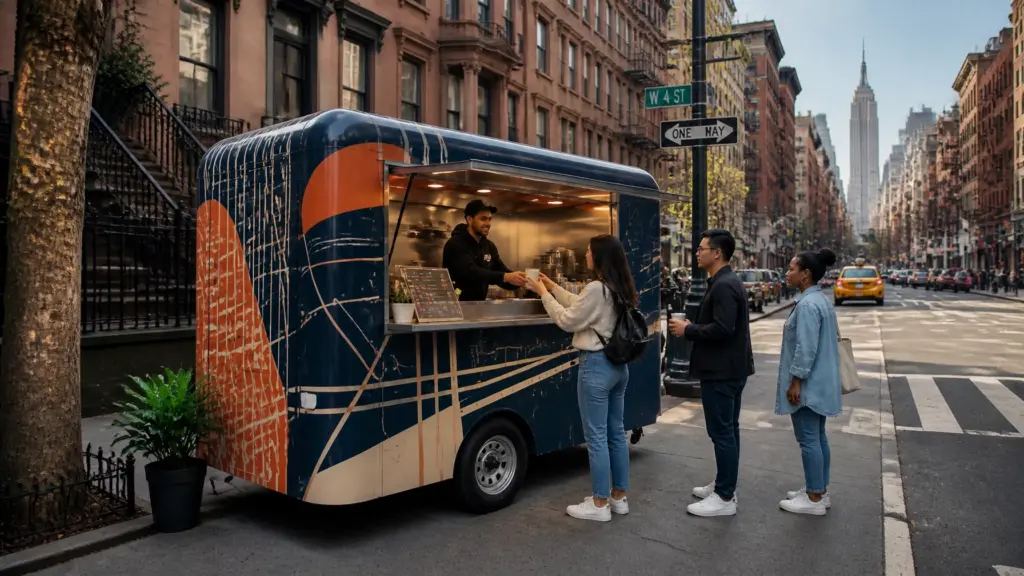
The exterior matters as well. A street vendor unit is a high-visibility marketing asset. Instead of applying a small logo to a plain box, use a complete wrap graphic that carries your brand across the rounded body, service side, rear, and towing side. A strong visual identity helps a coffee trailer, food trailer, or mobile bar stand out in a crowded streetscape.
What Does Daily Operation Look Like?
A reliable daily workflow should include:
- Collecting the unit from the approved storage or commissary location.
- Checking battery charge, electrical connections, refrigeration, water, and wastewater capacity.
- Confirming permits and required documentation are available.
- Inspecting food temperatures and inventory.
- Traveling to an approved operating location.
- Setting up without blocking pedestrian movement.
- Monitoring power use throughout the shift.
- Managing waste and cleaning the service area.
- Returning the unit for cleaning, servicing, charging, and secure storage.
Battery power can simplify the service environment by reducing generator noise, fuel handling, and exhaust. It does not remove the need for maintenance, electrical checks, safe charging, or compliance with applicable fire and building requirements.

Is Pourter a Good Fit for an NYC Street Vendor Project?
Pourter works with entrepreneurs, restaurants, chains, and established brick-and-mortar brands to create custom mobile units. The same planning process can support a compact coffee trailer, a branded concession trailer, a food trailer, or a mobile bar.
Explore Pourter’s custom food trailer projects, bar and beverage trailers, and full trailer collection to compare different approaches. Pourter’s work also includes battery-powered systems, integrated technology, custom layouts, and full-unit branding.
For operators searching for custom food trailers near me, food trailers near me, or a food trailer near me, the most important question is not only where the manufacturer is located. It is whether the builder can coordinate design, power, workflow, branding, and delivery around the city where the unit will operate.
What Is the Best First Step?
Start with a written concept brief. Include:
- Menu
- Boroughs and target locations
- Operating hours
- Expected daily volume
- Equipment list
- Service speed
- Battery or hybrid power preference
- Commissary plan
- Branding direction
- Permit pathway
Then confirm current requirements with NYC agencies and connect with vendor-focused resources such as SVP. A compliant, battery-optimized 5×10 unit is not created by choosing a size at the end of the process. It is engineered from the menu, location, and operating model forward.
For additional planning guidance, review Pourter’s article on lithium battery power for food trailers. When you are ready to discuss a custom build, Pourter can help translate your street vendor project into a durable, branded mobile business.
Regulations, fees, permit availability, and inspection requirements can change. Confirm current requirements directly with the NYC Department of Health and Mental Hygiene, DCWP, DSNY, NYC Parks, and other agencies applicable to your operation.